
A complete padel training routine moves through seven stages: warm-up, footwork, serve and return, baseline and walls, net play, overhead, and cool down. The order runs from movement to precision to power. This article sets out each stage with its drills, sets and reps, and explains why the same structure is what separates a benchmark padel club from a building with courts.
Key takeaways
- Seven stages, in this order: warm-up, footwork, serve and return, baseline and walls, net play, overhead, cool down.
- Movement before precision, precision before power. The overhead comes last, once the shoulder is fully warm.
- The serve is trained together with the approach to the net, as one movement.
- A shared method on court gives coaches, groups and new members one language. Players recognise that consistency as quality.
- Benchmark clubs combine premium courts, consistent coaching and programmes that build community.
The court comes first
A club can only be as good as its courts. Playing quality, ball response off the glass and the condition of the surface after years of use shape how players feel about a club long before any programme does. This is why PADEL1969 starts every project with the court. All PADEL1969 Premium Court models are FIP-compliant, and each is tailored to the client, from the sport grass fibre and colour to any RAL colour for the steel structure. For the full checklist, read how to choose a padel court, and why better quality is the cheaper investment in the long run.
The court opens the club. What happens on it decides whether players stay.
What does a complete padel training session look like?
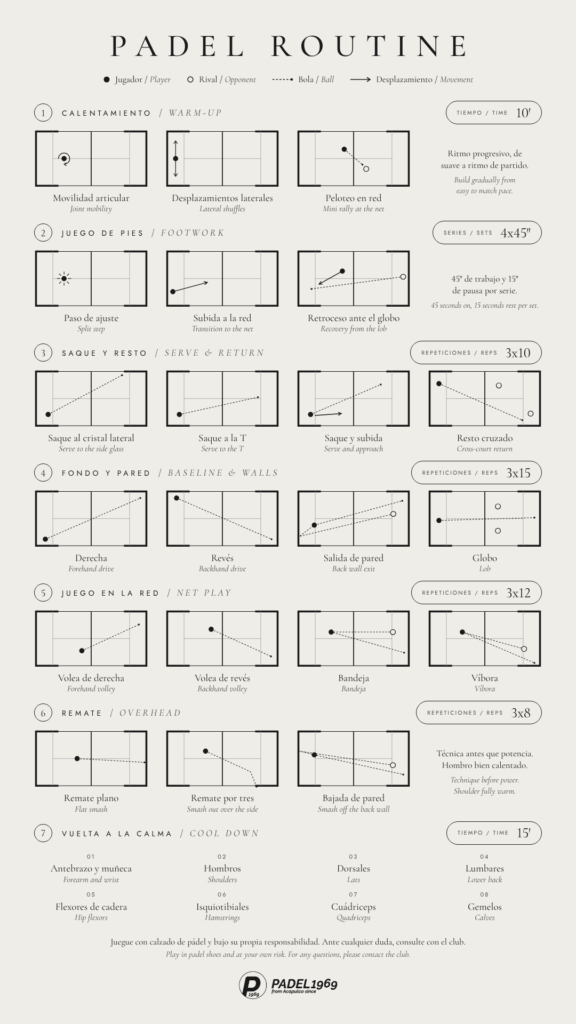
A session without structure is an hour of play. A session with structure is an hour of progress. The PADEL1969 Padel Routine sets out seven stages in the order the body needs them.
| Stage | Volume | Drills |
| 1. Warm-up | 10 minutes | Joint mobility, lateral shuffles, mini rally at the net |
| 2. Footwork | 4 x 45 seconds | Split step, transition to the net, recovery from the lob |
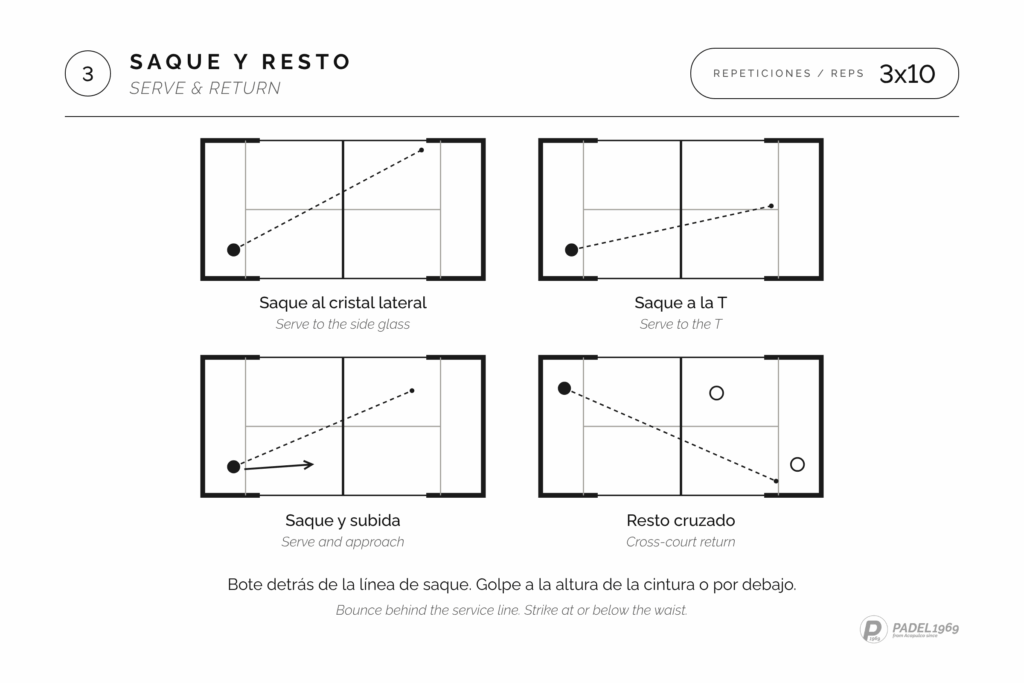
| 3. Serve and return | 3 x 10 | Serve to the side glass, serve to the T, serve and approach, cross-court return |
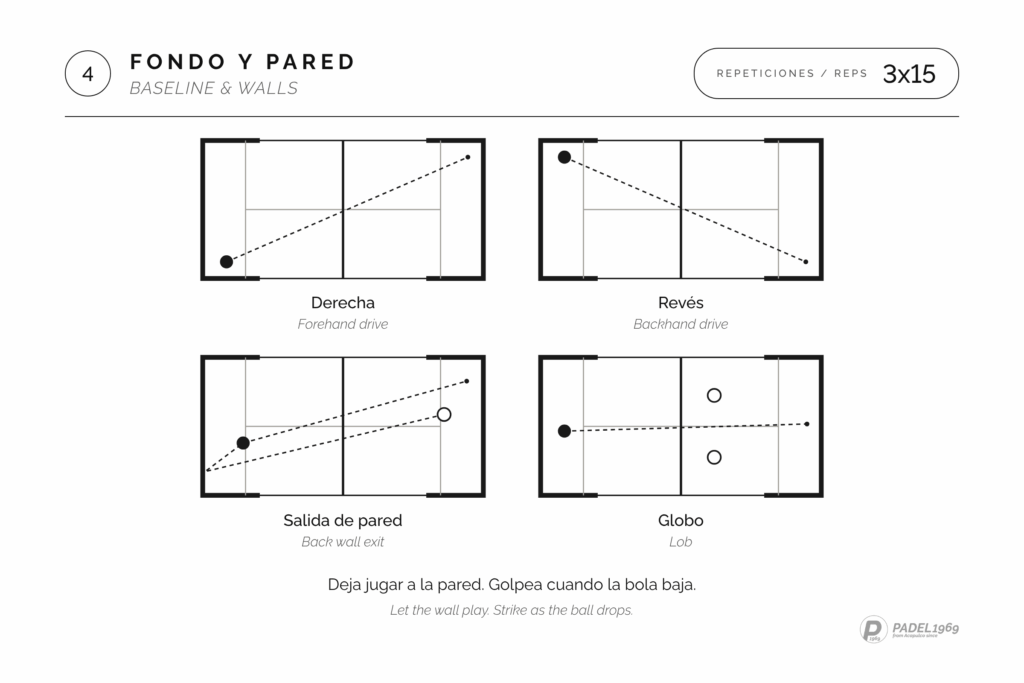
| 4. Baseline and walls | 3 x 15 | Forehand drive, backhand drive, back wall exit, lob |
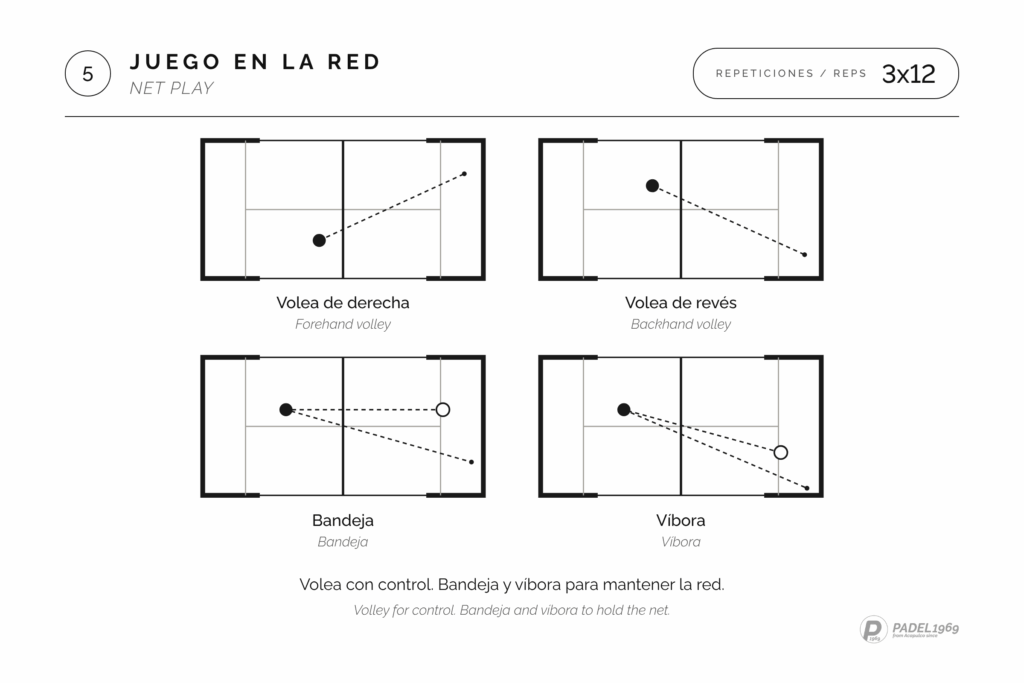
| 5. Net play | 3 x 12 | Forehand volley, backhand volley, bandeja, víbora |
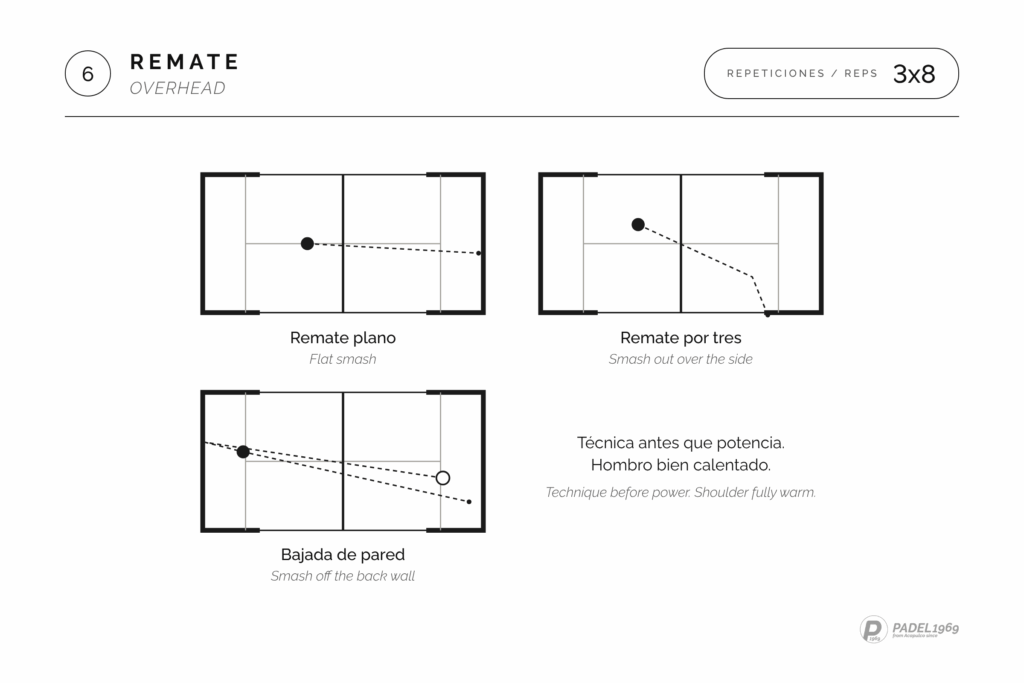
| 6. Overhead | 3 x 8 | Flat smash, smash por tres, smash off the back wall |
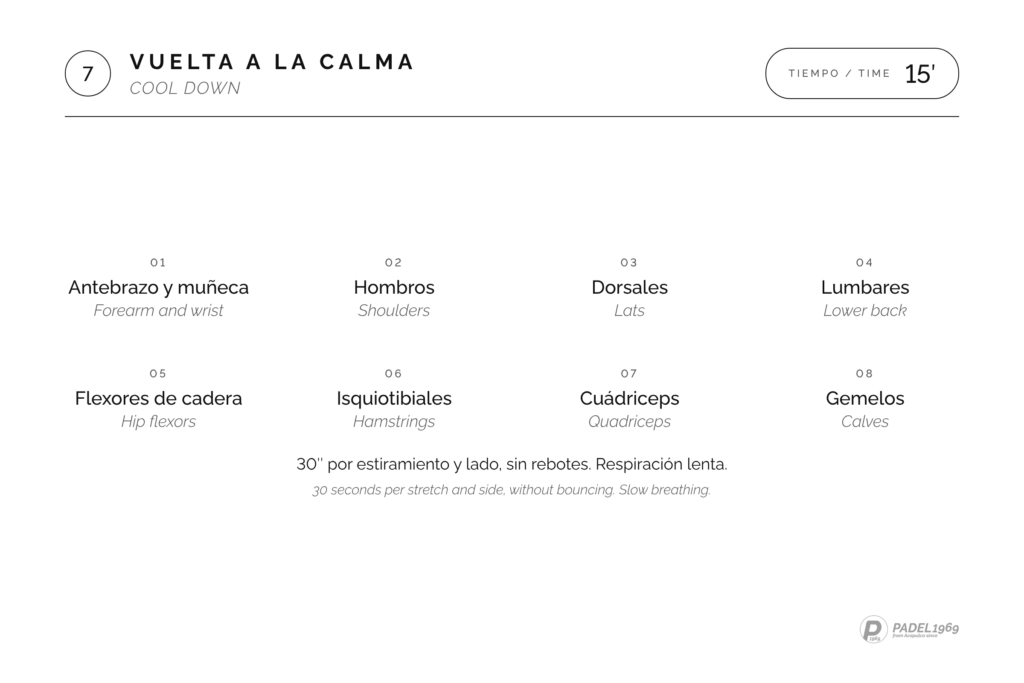
| 7. Cool down | 15 minutes | Eight stretches, from forearm and wrist to calves |
The seven-stage padel training routine at a glance
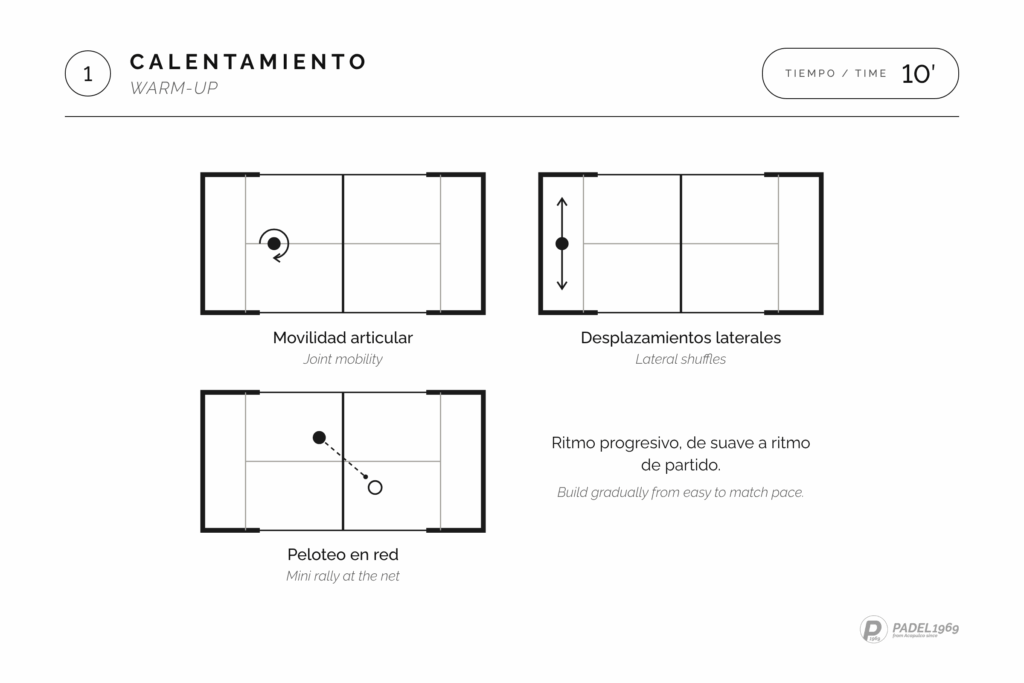
1. Warm-up
Time: 10 minutes
Joint mobility, lateral shuffles and a mini rally at the net. The pace builds gradually, from easy to match pace. The warm-up prepares the body for every stage that follows. We cover it in more depth in the importance of warming up before a padel match.
2. Footwork
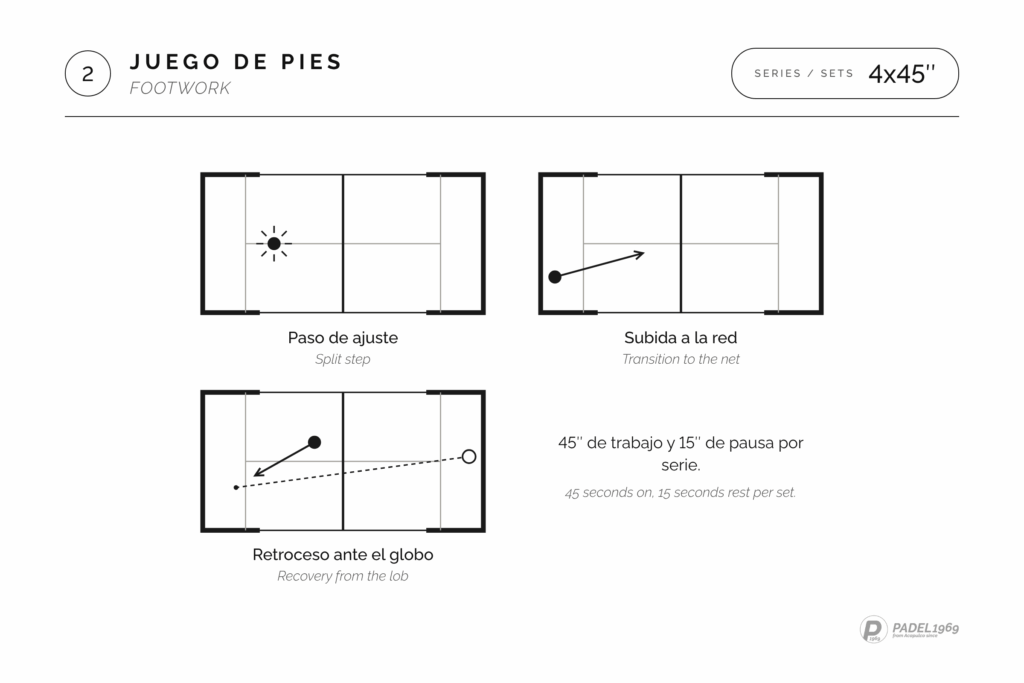
Sets: 4 x 45 seconds, 15 seconds rest
The split step, the transition to the net, and the recovery from the lob. In padel, position wins more points than power. Footwork is trained early, while the legs are fresh, so it carries into every shot later in the session.
3. Serve and return
Reps: 3 x 10
Serve to the side glass, serve to the T, serve and approach, and the cross-court return. The padel serve is underhand: the ball bounces behind the service line and is struck at or below the waist. Its value lies in placement and in the move to the net that follows, so the routine trains serve and approach as one movement. The return is the first chance to take the net away. For the rules, see padel service faults and padel return of serve rules.
4. Baseline and walls
Reps: 3 x 15
Forehand drive, backhand drive, the back wall exit, and the lob. The walls are what make padel its own sport. The principle is simple: let the wall play, and strike as the ball drops. The lob closes the block, as the shot that moves the opponents off the net.
5. Net play
Reps: 3 x 12
Forehand volley, backhand volley, the bandeja, and the víbora. At the net, control comes before pace. The bandeja is a controlled, sliced overhead that buys time and holds position. The víbora carries more side spin and pace, and puts the opponents under pressure off the walls. Both are covered in 10 padel shots everyone should know.
6. Overhead
Reps: 3 x 8
The flat smash, the smash por tres out over the side, and the smash off the back wall. This block comes late in the session for a reason. Technique before power. Shoulder fully warm. When a smash leaves the court, the out-of-court play rules apply.
7. Cool down
Time: 15 minutes
Eight stretches: forearm and wrist, shoulders, lats, lower back, hip flexors, hamstrings, quadriceps, and calves. Each stretch is held without bouncing, with slow breathing. The cool down ends the session with the same care it began with.
Why does the order of padel drills matter?
The sequence is the method. Movement comes before precision, and precision before power. The legs are ready before the first lob. The shoulder is warm before the first smash. A player who follows the same structure every week can measure progress against it, whatever their padel level, and a coach can build on it.
For a club, this matters beyond the individual session. A shared structure gives every coach, every group and every new member the same language. Players recognise that consistency as quality, and it is often what decides which padel club they choose.
What makes a padel club the benchmark in its city?
A routine on the wall is a small detail. It signals a larger one: the club has a method. Benchmark clubs share four qualities.
PREMIUM PADEL COURTS – The foundation that every other part of the club depends on.
A CONSISTENT TRAINING METHOD – The same structure across sessions, groups and coaches.
EXPERIENCED COACHING – The part of the club players experience every week. Coaches shape how a club develops its players, a theme David Campos discusses on youth and coaches.
COMMUNITY – Programmes that move players from first lesson to league play, and make the club a third place in its city, built on social moments as much as on matches.
We set out the wider path in From Good to Great: Building a Benchmark Padel Club. Operators who reach this point rarely do it alone, and learning it alone can be costly. Read how many padel club operators fail, and why, and the three compromises that turn padel club ownership into a headache.
Operational support from opening day
For new padel club investors, PADEL1969 continues after the courts are delivered. The support covers three areas.
Operations – Support from opening day, so the club runs with structure from its first booking.
Coaching – Experienced coaches placed at your club. Coaching quality is what players feel every week, and it is often the hardest position for a new club to fill.
Community – Programmes that turn players into members, and members into the community that defines padel in your city and region.
The aim is the same as with every court we build: a club that becomes the benchmark, and stays there. This is what we mean by PARTNER WITH EXPERIENCE. Investors at the planning stage can start with the padel club launch guide, our financial business plan article, and great or right location for a padel club. For the longer view, read the future of padel.
ONE COURT FOR LIFE® by PADEL1969
Frequently asked questions
What is a complete padel training routine?
A complete padel training routine moves through seven stages: a 10-minute warm-up, footwork in 4 sets of 45 seconds, serve and return in 3 x 10, baseline and wall play in 3 x 15, net play in 3 x 12, overhead in 3 x 8, and a 15-minute cool down with eight stretches.
In what order should padel drills be trained?
From movement to precision to power. Warm-up and footwork come first, technical shots from the baseline and the net follow, and the overhead comes last, once the shoulder is fully warm. The session ends with a cool down.
How long should a padel warm-up be?
The PADEL1969 routine uses a 10-minute warm-up of joint mobility, lateral shuffles and a mini rally at the net, building gradually from easy to match pace.
What is the difference between the bandeja and the víbora?
Both are overheads played to keep position at the net. The bandeja is a controlled, sliced shot that buys time and holds the net. The víbora carries more side spin and pace, and puts the opponents under pressure off the walls.
Why does the serve belong in a padel training routine?
Every point starts with the serve and the return. The padel serve is underhand: the ball bounces behind the service line and is struck at or below the waist. Its value lies in placement and in the move to the net that follows, so the routine trains serve and approach as one movement.
What makes a padel club a benchmark club?
Premium courts, a consistent method on court, experienced coaching, and programmes that turn players into members and members into a community in the club’s city and region.
Does PADEL1969 support padel clubs after court delivery?
Yes. PADEL1969 offers new padel club investors operational support from opening day, experienced coaches placed at the club, and programmes that build a padel community in the club’s city and region. Planning starts with a free Fast Track Call or an email to [email protected].
Plan your club
Planning a padel club in your city or region? Book a free Fast Track Call, or send your project details to [email protected].
PADEL1969 | SHAPE THE FUTURE OF PADEL
Contact for more: [email protected]
Author: Atte Suominen, CEO & Founder at PADEL1969