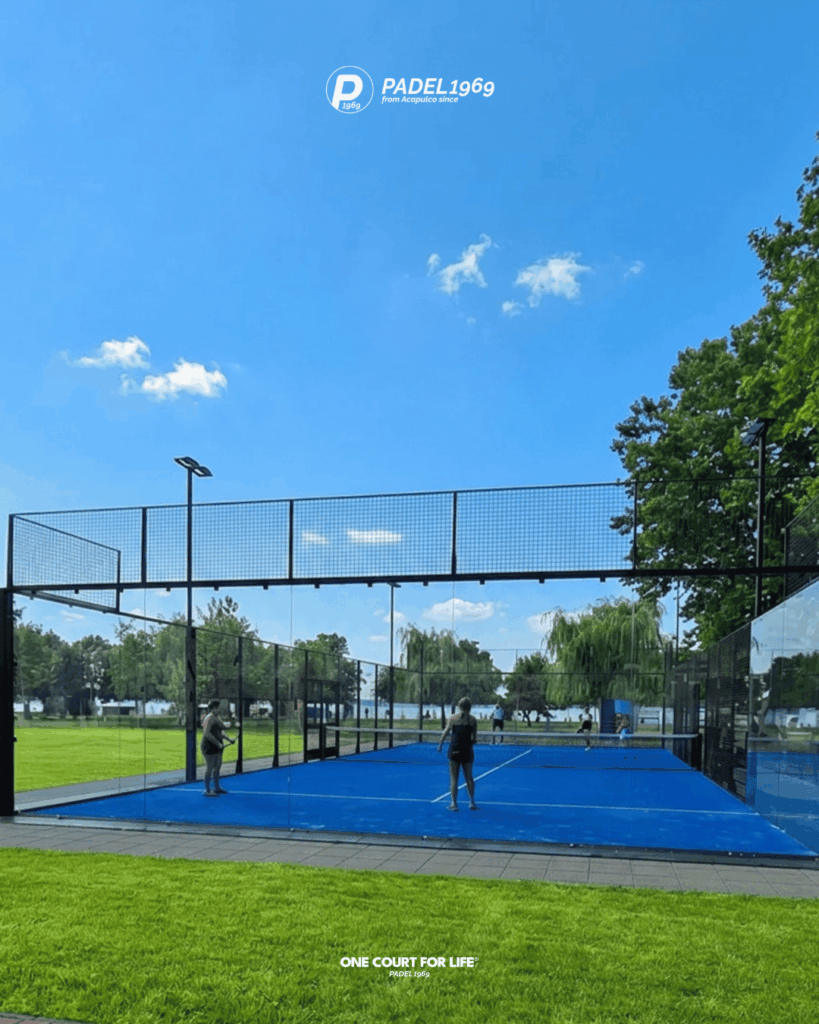
Every other component of a padel court is judged from a distance. The glass, the steel, the lighting: a player notices them once, forms an impression, and stops thinking about them. The turf is different. It is the only part of the court that the ball and the player are in continuous contact with, for every point of every match, for the next eight to ten years. It determines how fast the ball travels, how predictably it comes off the floor, how a player can move into a defensive position, and how the court photographs.
It is also the component most often chosen last, on the basis of a colour swatch and a price per square metre.
This article sets out how we specify turf at PADEL1969, and why. It covers the fibre constructions we recommend and the one we do not, the sand that is part of the surface rather than an accessory to it, the base tolerance that governs whether any of it matters, what the rules allow on colour, the full palettes available from the two manufacturers we work with, bespoke colour and its lifetime cost, and the maintenance regime that decides whether a surface reaches the end of its intended life or half of it.
What a padel turf system consists of
A padel surface is three elements working together, and a change to any one of them changes the way the court plays.
The fibre is extruded polyethylene, tufted into a backing at a defined density. Its shape, thickness and height govern how the surface behaves. Padel fibre is short, 10 mm to 12 mm, far shorter than football turf, because the ball must come off the floor cleanly rather than sink into the pile.
The backing is a double layer of polypropylene, fixed with a polyurethane coating that locks the tufts in place. On the Mondo systems that coating is applied at around 600 g per square metre over a 223 g backing, giving a tear resistance between 25 N and 50 N. For outdoor courts the assembly must be permeable, and the Supercourt XN system is rated at 500 mm per hour.
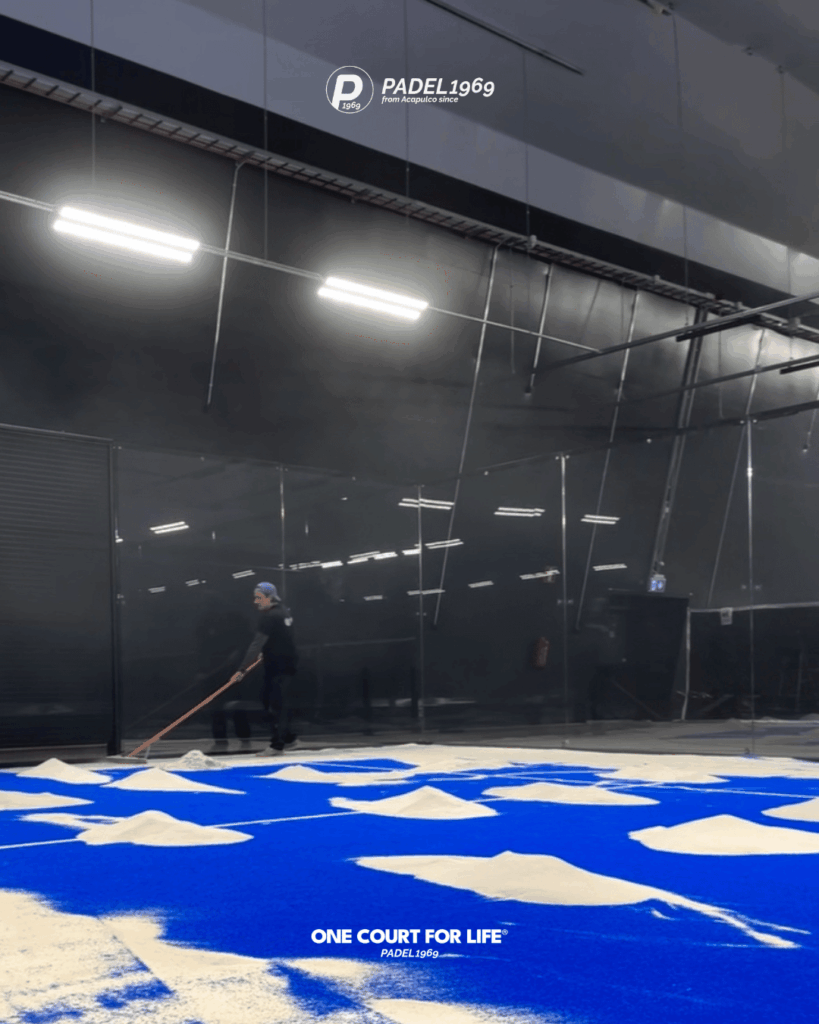
The silica sand infill is the third element and the least understood. Rounded, washed and dried quartz sand is brushed into the pile. It supports the fibre, provides grip, and sets the speed of the surface. The quantity is not a matter of preference. It is dictated by the fibre construction, and the difference between constructions is real: the texturised systems we specify take between 8 kg and 10 kg per square metre, while a straight or C section monofilament of 12 mm takes around 14 kg. Across a full 200 square metre court that is roughly 1.8 tonnes against 2.8 tonnes.
The three constructions, and the two we specify
Curly monofilament, our primary specification
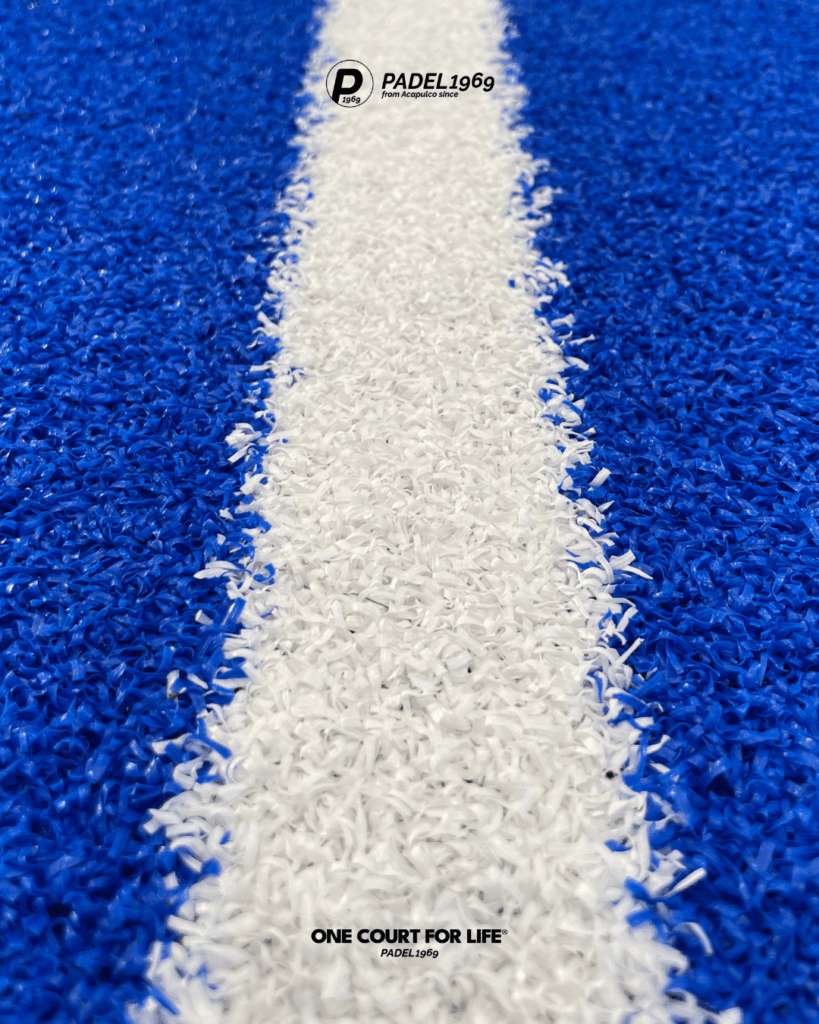
Curly monofilament, also called texturised or crimped monofilament, is an extruded fibre passed through a second thermo-mechanical process that introduces a permanent curl along its length. During play the curled filaments compress and return to their original state like a spring. The result is a fibre that stands up under load, recovers its shape, and holds the sand inside the pile rather than allowing it to migrate to the surface.
This is the construction we specify for the large majority of projects, indoor and outdoor. Three characteristics explain why. The bounce is uniform across the whole court, vertically and on angled contacts, before and after the ball rebounds off the glass, which is the single quality a serious player notices within the first three shots. The sand requirement is low, because the curl encapsulates the infill instead of relying on volume to hold the fibre upright. Less sand at the surface means less abrasion against fibre and ball, better grip, a lower risk of abrasion injuries in a slide, and a cleaner appearance over time. And the service life is the longest of the three constructions, because the fibre resists the matting that flattens a surface and ruins its consistency.
Curly monofilament in 10 mm pile is also what the professional game is played on. Mondo has been an official supplier to the top of the sport since 2015, and Premier Supercourt X3, a texturised system, is the Premier Padel and International Padel Federation official turf under an agreement running to the end of the 2026 season. That is not a marketing coincidence. It is the only construction that delivers tournament consistency and holds it through the volume of play a commercial club generates.
Straight monofilament, for warm outdoor climates
Straight monofilament uses the same polymer at a similar or higher dtex, but the fibre remains erect, with a shaped profile and an internal spine to give it stiffness and dimensional memory. Mondo STX runs at 9,300 dtex with a 260 micron filament in a 10 mm to 12 mm pile. Realturf Drive Pro Max uses a C shaped section with three internal nerves at 8,000 dtex in 12 mm.
We specify this construction selectively, for outdoor courts in warm, high radiation climates and for very high traffic sites. In those conditions a stiffer vertical fibre with a deeper sand bed is more forgiving of thermal cycling and of the fibre softening that intense heat produces, and the additional infill mass stabilises the surface. The trade-offs are honest ones and worth stating to any operator considering it. The ball is marginally slower, because upright fibre brakes it. The sand requirement rises to around 14 kg per square metre. And the brushing regime is more demanding, because that volume of sand redistributes under play and needs to be kept level.
Fibrillated, which we do not specify
Fibrillated turf uses flat tape fibres that split into a net-like lattice. When new it holds sand well and plays acceptably fast, and it is the cheapest construction on the market, which is why it remains common at the budget end of the category.
We do not offer it. The lattice that makes it work when new is the same structure that fails: the tapes continue to split, the fibre wears down, and the bounce becomes progressively less predictable long before the warranty period is finished. An operator who buys fibrillated turf has bought a surface that is at its best on the day it is installed and declines steadily from there. On a court intended to serve members for a decade that is a false economy, and it is the kind of saving that shows up as a resurfacing invoice and a membership problem in year four.
The base decides whether any of this matters
Turf cannot correct a base. A 10 mm pile of sand has no capacity to absorb a defect in the slab beneath it, and every irregularity in the concrete becomes an irregularity in the bounce.
The FIP rules set the playing rectangle at 10 m wide by 20 m long on interior measurements, with a tolerance of 0.5 per cent. Those are the dimensions. Flatness is a separate matter, and it is the one that decides how the court plays.
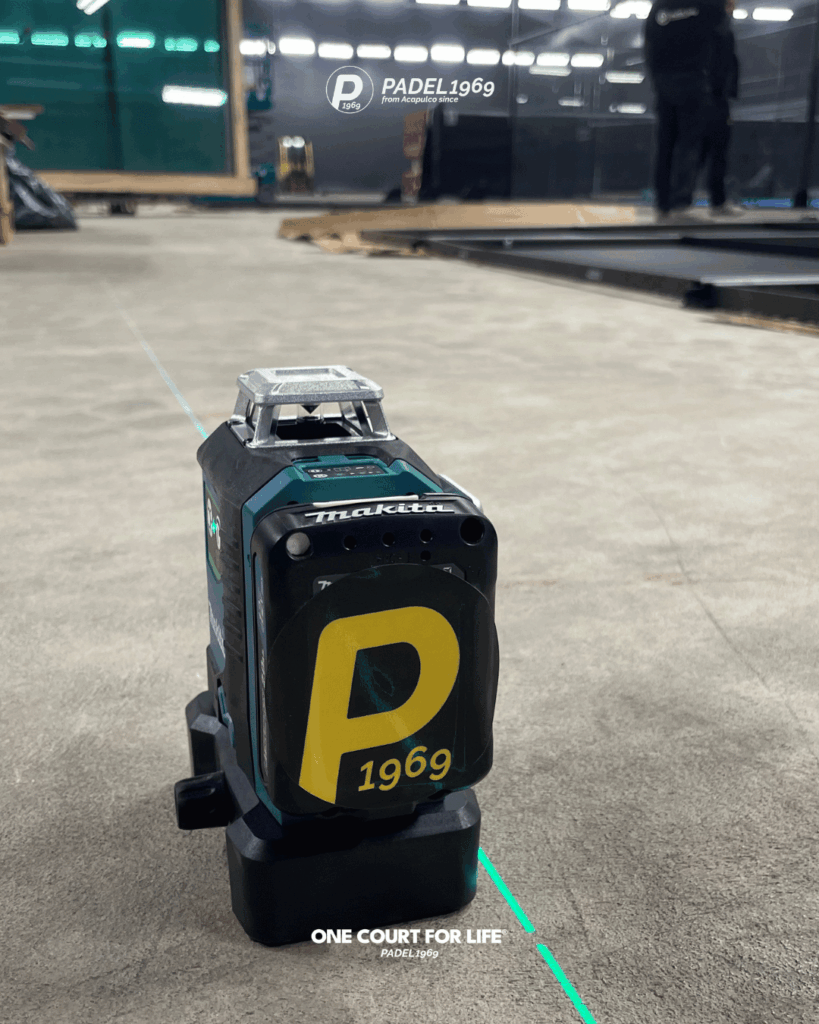
Our standard is a maximum deviation of 2 cm across 20 m, measured over the full length of the court. That is a cumulative flatness requirement, and it is what determines whether a ball behaves the same way at the back of the court as it does at the net.
Separately, the FIP rules cap local unevenness at three millimetres under a three metre straightedge, a ratio of one in a thousand. That is a local flatness rule, and it catches short waves and trowel marks a long measurement can miss. Both tests need to pass. A slab can satisfy one and fail the other, and a court that fails either will feel wrong to a good player who will not be able to explain why.
The surface beneath the carpet matters as much as its level. Manufacturers require a flat and slightly rough substrate such as asphalt or unfinished cement. Laying turf on hard, smooth surfaces such as marble, ceramics or a cement finished with a very fine trowel is expressly to be avoided, as is laying it over non-woven fabric substrates, because the carpet needs a surface it can key into and room for natural movement. On outdoor courts built without a drainage layer, the FIP rules cap the cross fall at one per cent, running from the centre out to the edges. That slope is deliberate and must be built in, not corrected later.
This is where the difference between one club and another is decided, before a single roll of turf arrives on site. A player who moves between clubs feels a flat court immediately, in the confidence with which they can commit to a shot after the wall. It is not a specification anyone puts on a brochure, and it is one of the few things a court builder cannot fix afterwards.
Rolls, joints and lines
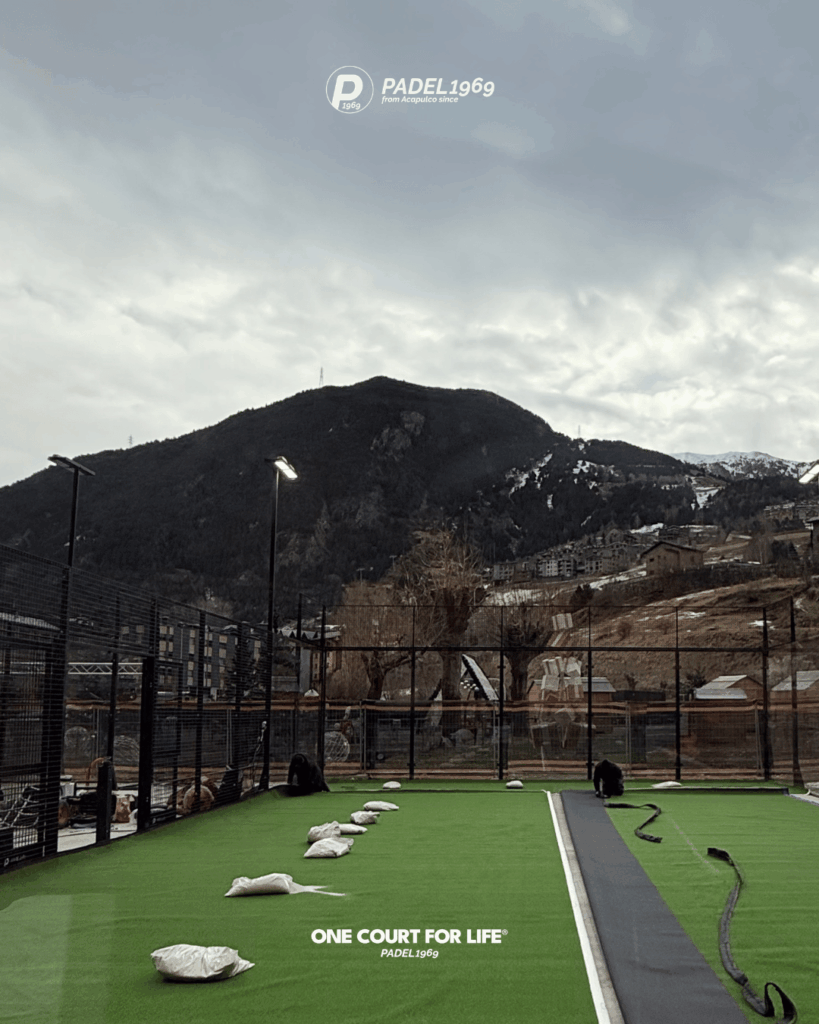
Turf arrives in rolls, and a 200 square metre court is covered by a handful of pieces. Where the joints between those pieces fall is a design decision, and the two manufacturers we work with answer it differently.
Realturf supplies Play Easy in rolls of 5 m by 14 m, two of them, plus a roll of 3 m by 20 m. Two five metre widths laid side by side cover the full ten metre width of the court across its central fourteen metres, which is almost exactly the distance between the two service lines, and the three metre roll is divided to cover the two end zones. The result is that the bonded seams coincide with the line layout: one running lengthwise down the middle of the court, where the central service lines sit, and two running across close to the service lines. Drive Pro Max is supplied in 5 m by 20 m and 2.5 m by 20 m rolls, so a court can be covered with two full length pieces and a single joint down the centre.
Mondo works to a maximum roll width of 4 m and a maximum roll length of 25 m, and publishes a production layout of 210 square metres per court in three rolls: 4.05 m by 20.2 m, 4.05 m by 24.4 m and 2.025 m by 14.5 m. Cut to the published plan these give two end strips of about 3.95 m, two side bands of 4 m and a central band of about 2 m. The joints therefore fall in open playing surface rather than under the lines, roughly a metre either side of the court centre and just inside each service line. Mondo joins the sheets with geotextile strips bonded with two component epoxy polyurethane adhesive, and requires trimming of at least 3 cm along the whole perimeter. Premier Supercourt X3 deliberately keeps the Supercourt XN layout, which is how Mondo holds the joint count down on the newer product.
Neither approach is wrong, and an operator should understand what each one is optimising. A joint is the weakest line in any turf system, the first place infill migrates through and the first place a lifted edge appears. Placing seams under the white lines makes them invisible and puts them where players rarely plant a foot. Placing them in open surface makes the bond itself carry the load, which is why the adhesive specification and the geotextile strip matter more in that layout. What fails in practice is neither of these: it is an improvised layout that adds joints through the service boxes and the back corners, where the load is highest and the wear begins.
The lines themselves are not painted. They are embedded in white turf of the same material, which is why they wear at the same rate as the rest of the court rather than fading and changing the grip locally. The FIP rules require a finished width of exactly 5 cm, in white or black by preference, for contrast against the floor. Realturf supplies its white strip at 7 cm so the installer can trim to a clean, straight 5 cm on site; the extra material is cutting allowance, not the finished line. The rulebook also requires the two halves of the court to be absolutely symmetrical in both surface and line layout, and the central service line to extend at least 20 cm beyond the service line. All three of those are set at the moment the lines are cut, and none is adjustable afterwards.
What the rules permit on colour
Before the palette, the constraint. The FIP Rules of Padel are narrow and specific on surface colour, and the wording matters for any club with competition ambitions. The edition in force applies from 1 January 2026 and incorporates the revision adopted in Acapulco in November 2025.
Colour is restricted to the green, blue and terracotta families, in a single colour across the whole floor, clearly distinct from the wall colour. Opaque walls are held to the same discipline from the other direction: a single uniform colour, clearly different from the floor.
Colour is also a visibility requirement rather than only an aesthetic one. The rules allow the ball to be white, yellow or another colour, provided it has an appropriate and clear contrast with the surface colour. Surface and ball are regulated as a pair, which is the technical basis for the professional game’s preference for blue.
The permitted list is shorter than the market. Black, grey, red, violet and orange are all manufactured, installed and played on across Europe, and they are legitimate choices for a club that is not hosting sanctioned competition. They are not named in the rulebook. An operator planning to host FIP-sanctioned events should keep the surface inside the green, blue and terracotta families and treat everything else as a brand decision for social and league play. We would rather state that plainly at specification stage than have a club discover it when it applies to host.
What the rules require of the surface
The ground surface section of the rulebook runs to five clauses. Restated precisely, they require the following.
Clause 1 permits three surface types, cement, synthetic material and artificial grass, subject to a single performance test: the surface must produce a regular bounce.
Clause 2 restricts colour to the green, blue and terracotta families, described in the rulebook as “green, blue or terracotta, or their various like tones”, in one colour across the whole floor and clearly distinct from the wall colour.
Clause 3 sets local flatness at three millimetres under a three metre straightedge, a ratio of one in a thousand.
Clause 4 caps the cross fall on courts built without drainage at one per cent, running from the centre out to the edges.
Clause 5 hands every remaining technical requirement for synthetic and artificial grass surfaces to a separate document, the Annex Courts’ Homologation issued by the FIP.
Source: FIP Rules of Padel, Ground Surface, clauses 1 to 5, edition applying from 1 January 2026, published by the International Padel Federation at padelfip.com.
That fifth clause deserves attention from anyone specifying a court. The rulebook itself contains no numbers for a turf surface: no friction range, no rebound tolerance, no pile or infill specification. All of it sits in an annex that is referenced five times across the rules and is not published in the documents section of the FIP website. In practice this means the homologation requirements for the playing surface are administered rather than published, and an operator who needs them has to request them. Anyone quoting specific FIP surface figures at you should be asked which document they are reading.
The colour palettes
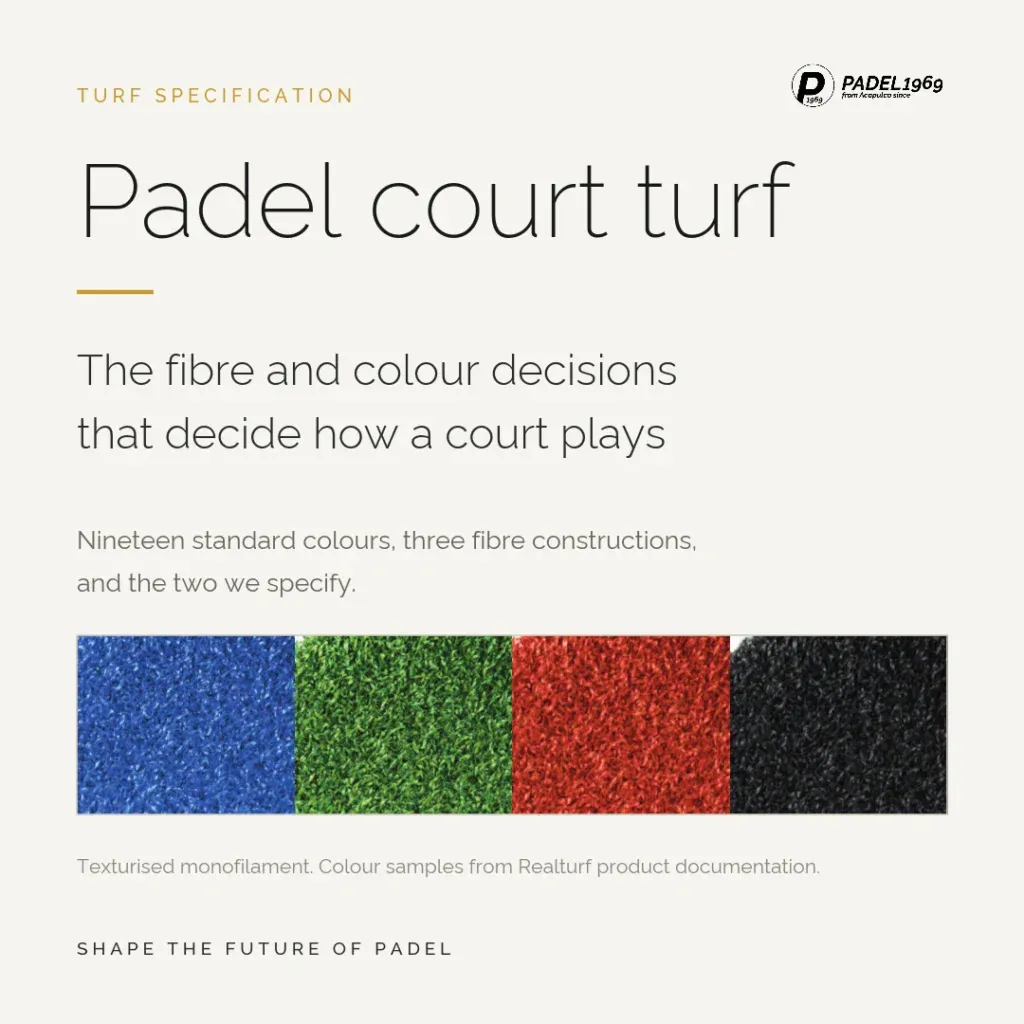
We work primarily with two manufacturers, Realturf and Mondo. Between them they cover nineteen standard colour and construction combinations, and the two graphics below show the actual product colours rather than approximations.
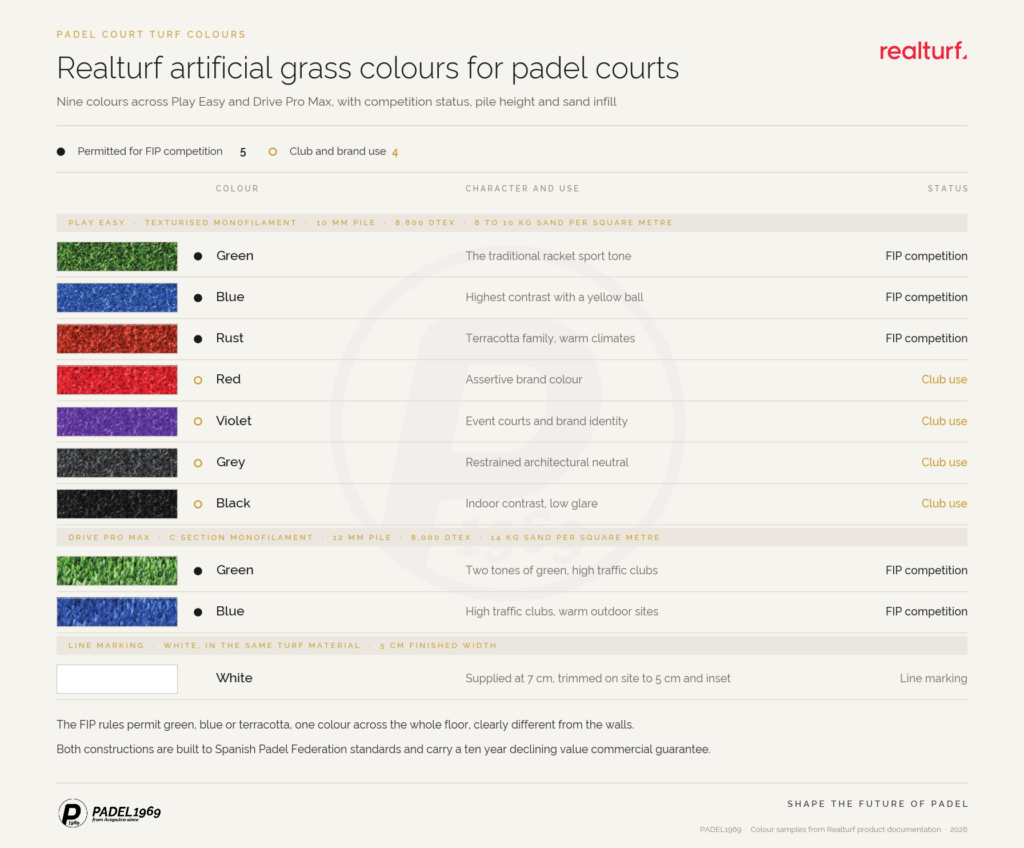
Realturf offers two models for padel. Play Easy is a texturised monofilament at 10 mm and 8,800 dtex, available in green, blue, rust, red, violet, grey, black and white, with white reserved for line marking. Drive Pro Max is a C section monofilament at 12 mm and 8,000 dtex in green, supplied as two tones of green, and blue. Both are built to Spanish Padel Federation standards and carry a ten year declining value commercial guarantee.
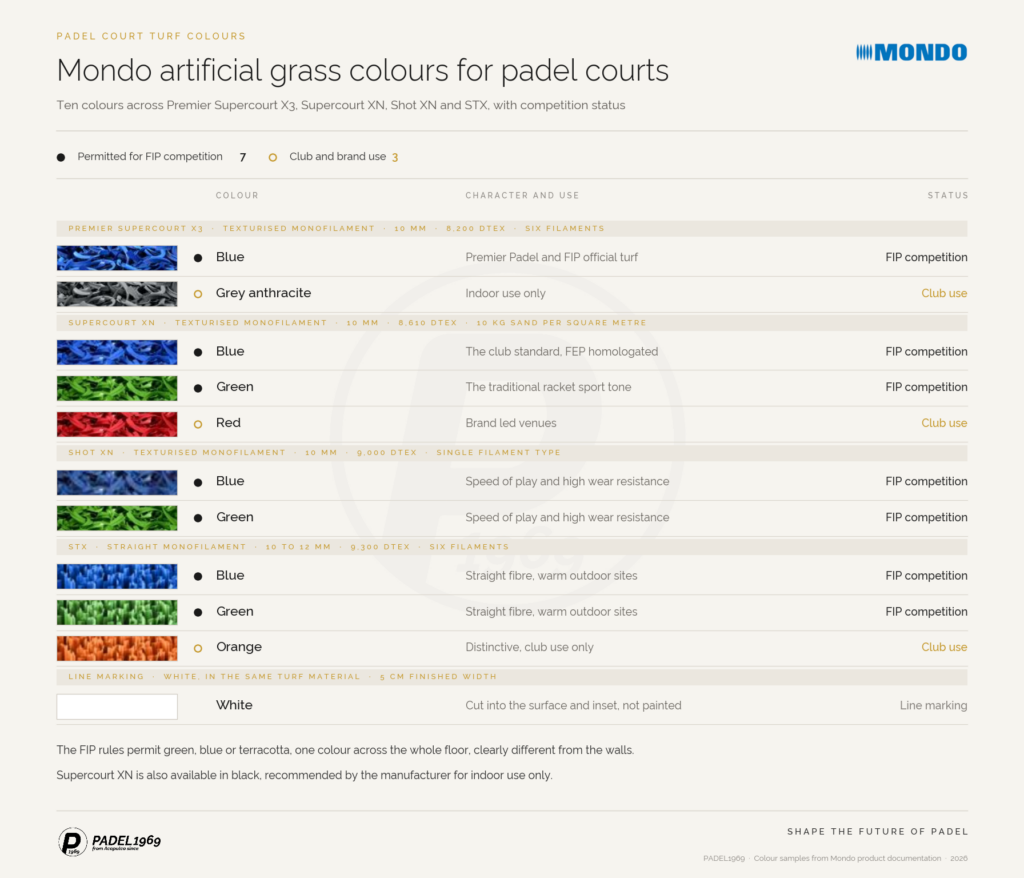
Mondo offers four systems. Premier Supercourt X3 in blue and grey anthracite, Supercourt XN in blue, green, red and black, Shot XN in blue and green, and STX in blue, green and orange. The grey anthracite and the black are recommended by the manufacturer for indoor use only.
On heat, the physics is simple and worth being direct about. Dark surfaces absorb more solar radiation and run hotter. The professional game learned this publicly: an outdoor tournament played on a black court in central Spain in the summer of 2015 was uncomfortable enough for players and spectators that the surface was replaced with blue. Black, grey anthracite and other dark tones belong indoors, which is exactly what both manufacturers state. Lighter tones stay cooler and are the safer specification for hot, exposed sites.
On fade, quality padel yarn carries ultraviolet stabilisers introduced at extrusion rather than applied afterwards. Both suppliers rate their padel fibre above grade 3 on the UNE-EN 20105-A02 colour fastness scale, and Mondo formulates its polyethylene to be self-lubricating with high resistance to abrasion and ultraviolet light. Saturated and unusual pigments, particularly reds, rusts and violets, still show visible change earlier than blue or green under continuous sun. It is not a defect. It is pigment chemistry, and it should be part of the decision on an exposed outdoor court.
Bespoke colour, and what it costs across the life of the court
Almost any colour is achievable. Yarn can be extruded to a specified reference and tufted to the same construction as the standard products, which means a club can match a corporate identity, a hotel palette or an architect’s scheme exactly. The practical lead time for a bespoke colour is approximately twelve weeks from confirmed reference to delivered rolls, against a short lead for stock colours.
The cost to consider is not the surcharge on the original order. It is the cost of the next ten years.
A bespoke colour exists as one production batch. If a section of turf is damaged, by a contractor working inside the court, by a heater, by a failure at a seam, the repair depends on material from that batch. If the offcuts have been discarded, new yarn must be extruded, which means a minimum order quantity, a twelve week wait, and a dye lot that will not match the aged surface beside it. A stock colour in the same situation is a short order and a repair nobody notices.
Two disciplines make bespoke colour a sound decision rather than a liability. Order surplus material at the outset, enough for at least one substantial repair, and store it flat, dry and out of light on site. Record the exact yarn reference, batch number and production date in the club’s own documentation rather than relying on the supplier’s records years later.
Handled that way, a bespoke colour is a real differentiator. Handled carelessly, it converts a minor repair into a full resurface.
Keeping the surface alive
Turf does not wear out evenly. It fails where it is neglected, and the failure is almost always the same: the fibre lies down, the sand compacts, and the bounce dies. Nothing recovers a matted surface. It can only be prevented.
Three things accumulate on a padel court and all three must be removed. Dust settles constantly, outdoors from the environment and indoors from the building itself, and works into the sand where it binds the grains together and makes the infill behave like a solid rather than a bed. Ball fluff, the felt shed from every ball, is the material clubs underestimate most. It builds as a fine layer at the base of the pile, seals the surface, and holds moisture. Organic debris, leaves, pollen, seeds and grass clippings on outdoor courts, breaks down into the same binding material.
Brushing is the answer to all of it. Brushing lifts the fibre back to vertical, redistributes the sand evenly across the court, and pulls fluff and dust to the surface where they can be removed. The direction matters: brushing should vary rather than always follow the same line, so the fibre is not trained to lean one way.
A workable regime for a commercial club looks like this. Brush weekly, by hand with a stiff drag brush on a single court, or with a towed brush behind a small machine where several courts are managed together. Concentrate on the high wear zones, which are the service areas and the back corners where players position for the wall. Remove surface debris before it is brushed into the pile rather than after. Check the sand level monthly and top up where the fibre is beginning to show more of itself than elsewhere, particularly along the back wall on outdoor courts where wind moves infill laterally. Once or twice a year, carry out a deep decompaction, which lifts and separates the sand bed rather than simply moving it, followed by a fresh sand top-up and a full brush.
Indoor courts benefit from occasional light irrigation, which settles dust and reduces static. Outdoor courts receive that from rainfall in most European climates. One further discipline is easily overlooked: avoid leaving equipment or furnishings standing on the surface for long periods, because the carpet needs freedom to move naturally and a static load prevents it.
The economics are favourable and rarely presented to operators clearly. Turf maintenance runs in the region of two to three euros per square metre per year. A resurface, when it becomes necessary, is a five figure sum per court. A club that brushes weekly reaches the far end of the expected life of a surface. A club that does not can lose a third of it, and will spend two of those years apologising to members for a court that plays inconsistently.
Expected life and the replacement decision
Service life depends on construction, traffic, climate and maintenance, and honest ranges are more useful than a single number. A curly monofilament surface under a disciplined maintenance regime should be expected to give eight to ten years of commercial play, and can exceed it indoors. Heavy traffic, hot exposed sites and neglected brushing pull that figure down towards six. Fibrillated surfaces, for the reasons set out above, decline earlier and less predictably, which is the principal reason we do not offer them.
Resurfacing should be budgeted from the outset rather than treated as an unexpected event. Turf and infill together typically represent between a fifth and a third of the cost of a court build, and replacement of turf and sand with labour commonly falls in the range of five to ten thousand euros per court in Europe. An operator who builds that into a ten year model has a business. An operator who does not has a surprise.
The full specifications, system by system
The tables below are the complete published specifications for every padel turf system we supply. They are reproduced in full because operators, architects and investors comparing tenders are entitled to see the same numbers we work from.
Mondo
Mondo produces its padel turf at the MondoTufting plant in Borja, Spain, opened in 2002 and now extending over about 16,200 square metres, with extrusion lines for monofilaments and fibrillated fibres and more than twenty fibre types made on site. Mondo has been a FIFA licensee since 2003, was the first manufacturer to have padel turf type-approved by the Spanish Padel Federation in 2012, supplied the World Padel Tour from 2015 to 2023 with Supercourt XN as the official product, and has been the official turf of Premier Padel and the International Padel Federation since 2024.
| Specification | Premier Supercourt X3 | Supercourt XN | Shot XN | STX |
|---|---|---|---|---|
| Construction | Texturised monofilament | Texturised monofilament | Texturised monofilament | Erect monofilament |
| Fibre types | XNOVA, XOMEGA, XDELTA | STX Text, XNOVA Text | XNOVA | STX |
| Filament count | Six, two of each type | Six, three of each type | Eight | Six |
| Composition | 100 per cent polyethylene | 100 per cent polyethylene | 100 per cent polyethylene | 100 per cent polyethylene |
| Yarn dtex | 8,200 | 8,610 | 9,000 | 9,300 |
| Filament dtex | 1,150 / 1,475 / 1,475 | 1,720 / 1,150 | Not published | Not published |
| Filament thickness | 170 / 200 / 200 micron | 250 / 170 micron | 170 micron | 260 micron |
| Pile height | 10 mm | 10 mm | 10 mm | 10 mm to 12 mm |
| Gauge | 3/16 inch | 3/16 inch | 3/16 inch | 3/16 inch |
| Stitches per square metre | 46,200 | 46,200 | 35,700 | 48,300 |
| Fibre weight | 1,306 g/m² | 1,393 g/m² | 1,178 g/m² | 1,405 g/m² |
| Backing weight | 223 g/m² | 223 g/m² | 223 g/m² | 223 g/m² |
| Coating weight | 600 g/m² | 600 g/m² | 600 g/m² | 600 g/m² |
| Total weight | 2,129 g/m² | 2,216 g/m² | 2,001 g/m² | 2,228 g/m² |
| Colours | Blue, grey anthracite | Blue, green, red, black | Blue, green | Blue, green, orange |
| Indoor only | Grey anthracite | Black | Not applicable | Not applicable |
| Infill | Silica sand | Rounded quartz, 97 per cent silicon, 0.315 to 0.8 mm, 10 kg/m² | Silica sand | Silica sand |
| Maximum roll size | 25 m by 4 m | 25 m by 4 m | 25 m by 4 m | 25 m by 4 m |
| Lines | White, inset, 5 cm | White, inset, 5 cm | White, inset, 5 cm | White, inset, 5 cm |
Supercourt XN carries the fullest published test record of the four. It is laboratory certified to DIN 18035-7 and EN 15330-1, classified ITF Category 4 Medium-Fast, homologated by the Spanish Padel Federation under UNE 147301, and certified GREENGUARD and GREENGUARD Gold for low chemical emissions. Water permeability is 500 mm per hour for outdoor courts, maximum roll size is 25 m by 4 m, and tear resistance after finishing is between 25 N and 50 N. Under EN 13501-1 the system is classified Bfl-s1 for reaction to fire when laid loose or glued on a non-combustible substrate with 10 kg per square metre of silica sand. The XNOVA filament carries a built-in elastomer that increases resilience and softness, and the parallelepiped section with four grooves and four asymmetrical ribs stiffens the sides of the filament.
Premier Supercourt X3 is the first padel system on the market to combine three distinct filament morphologies in one yarn. Mondo attributes seven improvements to it: court grip, shock absorption, sand encapsulation, uniformity of angled and vertical bounce, aesthetic uniformity, low maintenance with no displacement or accumulation of sand, and quick installation, since it retains the Supercourt XN roll layout of three rolls per 200 square metre court and therefore the same number of joints.
At company level, Mondo holds ISO 9001, ISO 14001, ISO 50001 and ISO 14064 certification, complies with REACH, and has had the components of the Supercourt XN system analysed by the Spanish National Research Council, which concluded that they are fully recoverable thermoplastic and thermosetting polymers. Development follows the UNE 166002 research and innovation standard, and the plant runs a solar photovoltaic installation.
Realturf
| Specification | Play Easy | Drive Pro Max |
|---|---|---|
| Construction | Textured monofilament | C section monofilament, three nerves |
| Composition | Polyethylene | Polyethylene |
| Dtex | 8,800 | 8,000 |
| Pile height | 10 mm | 12 mm |
| Gauge | 3/16 inch | 3/16 inch |
| Stitches per square metre | 48,500 | 53,300 |
| Fibre weight | 1,300 g/m² | 1,200 g/m² |
| Total weight | 2,650 g/m² | 2,300 g/m² |
| Primary backing | Polypropylene | Polypropylene |
| Secondary backing | Latex | Latex |
| Colours | Green, blue, rust, red, violet, grey, black, white | Two tones of green, blue |
| Roll sizes | 5 m by 14 m in two rolls, 3 m by 20 m | 5 m by 20 m, 2.5 m by 20 m |
| Infill | Rounded silica sand, 0.2 to 0.5 mm, 8 to 10 kg/m² | Rounded silica sand, 0.5 to 1.0 mm, 14 kg/m² |
| Lines | White, supplied at 7 cm, trimmed to 5 cm | White, 5 cm in the same material |
Both Realturf systems are tested for ultraviolet stability above grade 3 under UNE-EN 20105-A02, permeability of 32.5 litres per minute per square metre under UNE-EN 12616:2014, chlorinated water stability under ISO 105-E 03:2010, freedom from bacteria under ASTM G 21:2013, and non-toxicity under EN 71-3. Both are classified non-flammable under EN 13501, are manufactured under ISO 14001 with a zero waste process, and are certified 100 per cent recyclable by the Spanish National Research Council. Line marking complies with Spanish Padel Federation requirements.
Specifying with intent
The turf decision comes down to a short sequence. Choose curly monofilament unless the site is a hot outdoor climate or a very high traffic venue where straight or C section monofilament is the better engineering answer. Build the slab to 2 cm over 20 m and 3 mm under a 3 m rule, on a substrate the carpet can key into, because no fibre corrects a base. Choose colour with the competition rules, the climate and the camera in mind, and if the colour is bespoke, buy the spare material and record the batch. Then brush it, every week, for the life of the court.
None of this is complicated. It is simply decided properly, once, at the point where it can still be decided.
About PADEL1969
PADEL1969 delivers precision engineered premium quality padel courts and advisory services to help our clients become local benchmarks in padel club operations. The name refers to Acapulco in 1969, the place and the year the sport was invented, and it sets the standard the company measures itself against.
The company is family owned, works to a long horizon, and is selective about the projects it takes on. A court installed this year will be judged by the players using it a decade from now, which is the only measure of a manufacturer that matters.
Enquiries: [email protected]
PADEL1969 | SHAPE THE FUTURE OF PADEL