
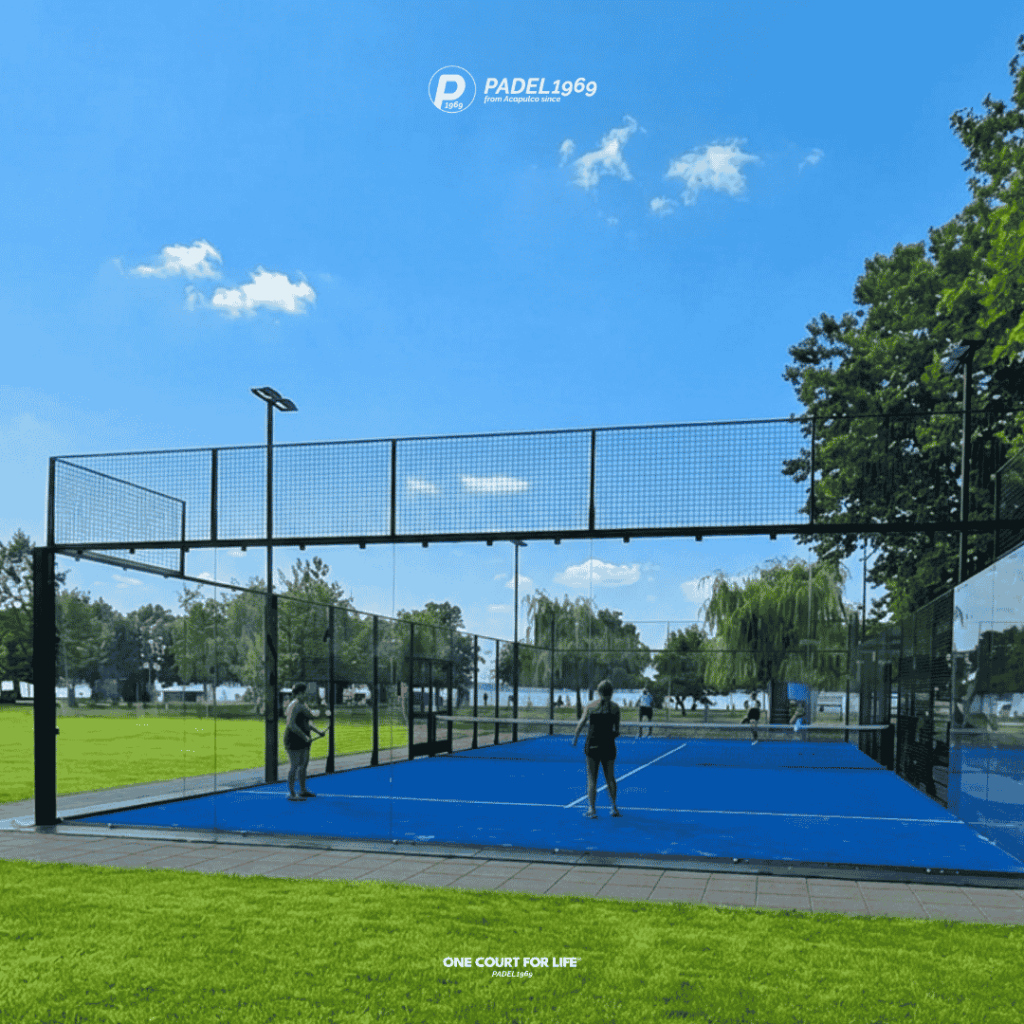
A pop-up padel court lets a serious operator test real demand at a location before committing capital to a permanent facility. It is a fully portable premium court, installed in days, that turns a car park, a rooftop, a shopping centre forecourt, or an event space into a live demand test. You learn what a site actually generates before you build on it.
The case for this approach strengthens as the sport grows. Search interest in padel in the United Kingdom rose 121 percent year on year into 2025, and Great Britain passed 1,000 courts across 325 venues in July 2025. In the United States, court numbers reached 688 across 180 facilities, with more than half built since the start of 2024. Rapid growth invites rapid building, and rapid building on unproven assumptions is where the losses begin.

What is a pop-up padel court
A pop-up padel court is a portable, FIP-compliant court that can be installed and removed without permanent groundworks. It is engineered to move between sites while holding its value as an asset. Operators use it to test a location for a defined period, commonly 30 to 90 days, and to decide whether that site justifies a permanent facility.
The term is used interchangeably with portable padel court and mobile padel court, and the same structure is sometimes called a temporary or relocatable padel court. What separates a premium version from an event-hire unit is the specification. The court is built to the standard a permanent installation would hold, not to a lower temporary grade.
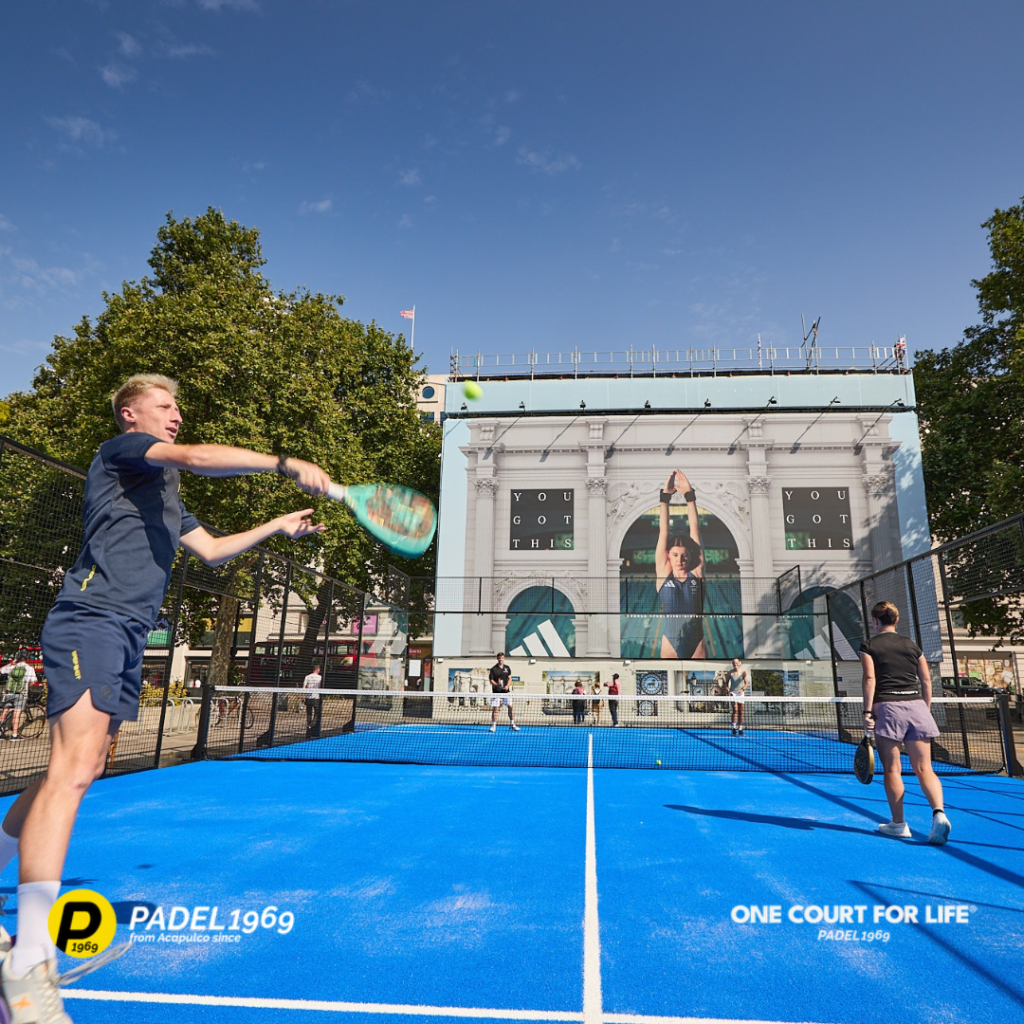
Why test demand before building a permanent facility
Most padel projects do not fail in construction. They fail on assumptions made long before the first foundation is poured. Location, demand, pricing, and peak hours are modelled on paper and rarely proven in the field, and the capital committed against that model is real long before any of it is confirmed.
Sweden is the clearest warning. The market built thousands of courts in a few short years, and the correction was severe. By the end of 2024, more than 100 facilities had closed and roughly 90 padel companies had entered bankruptcy, with one large operator shutting 50 of its 63 clubs. Close to 500 million euros of capital was destroyed. The demand assumed on paper was not the demand the market delivered. We have written before about how to invest responsibly in padel after that boom and bust, and the lesson holds: in a fast-growing sector, early success can hide deep flaws.
A portable court addresses this directly. It replaces estimated demand with observed demand, at a fraction of the exposure.
How do you test padel demand at a location
To test padel demand at a location, install a portable premium court on a short lease, operate it for 30 to 90 days with real hourly pricing, and measure utilisation and repeat bookings. Strong sustained utilisation at your target price confirms genuine demand. If the numbers hold, you build. If they do not, the court moves.
In practice the sequence is straightforward. Shortlist the candidate sites. Secure a short-term site agreement rather than a purchase or long lease. Install the court, which takes days rather than the months a permanent build requires. Run live bookings at a real market rate and capture the data: bookings per week, time-of-day distribution, the price point at which demand holds and the point at which it softens, and the share of players who return. Then decide, on evidence gathered on that exact ground, whether the location earns a permanent facility. This is the same discipline we apply in advisory work, where the right location is validated through data rather than instinct.
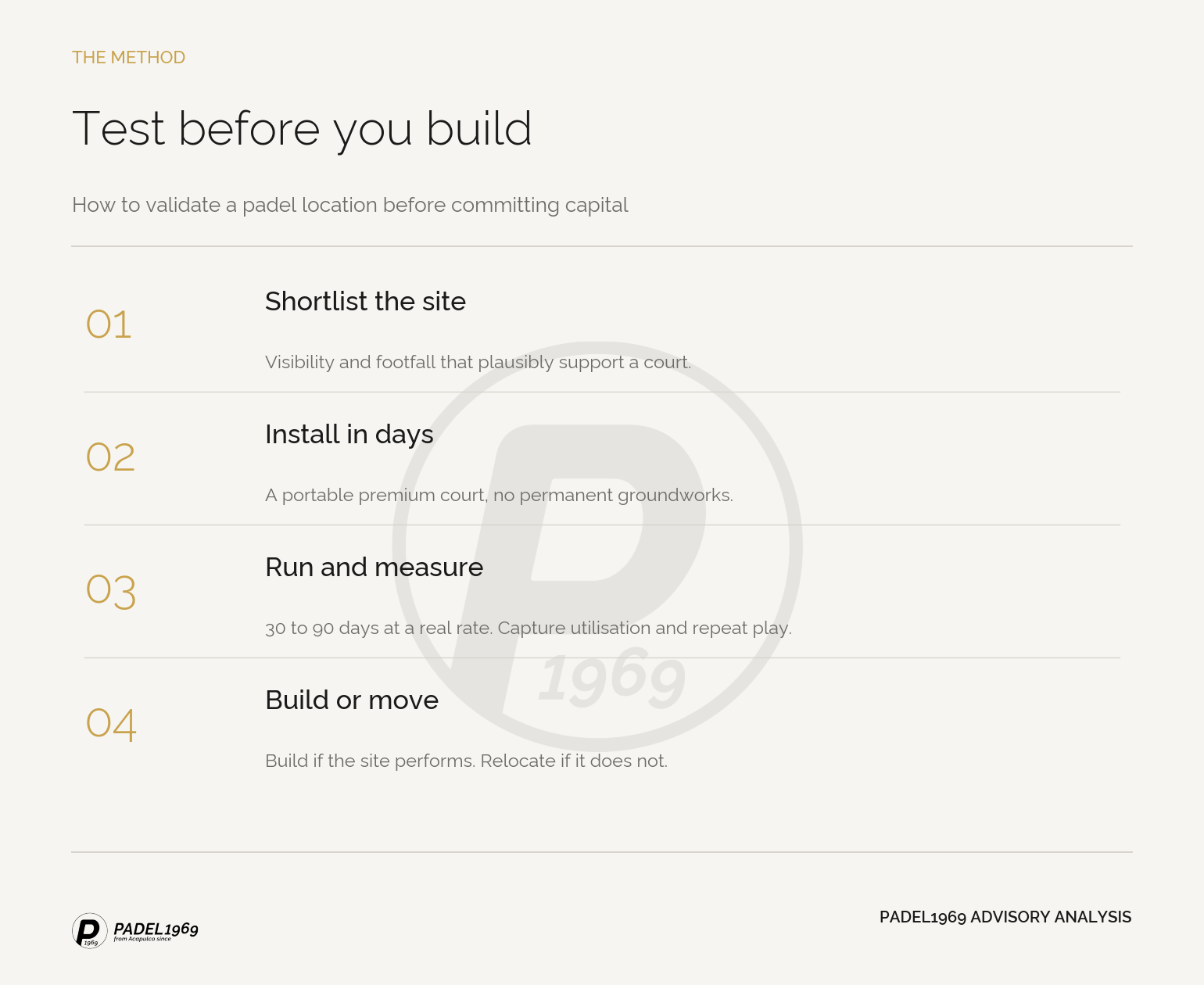
How to test padel demand before committing to a permanent build.
How much money can a padel court make
A single padel court’s revenue is a function of three numbers: the hourly rate, the utilisation, and the bookable hours per day. At 13 bookable hours a day across 30 days, a court offers 390 bookable hours in a month. At a premium urban rate, a well-marketed court in a strong location can sustain high utilisation across that window.
Worked at a rate of 40 GBP per hour, which is approximately 47 EUR or 54 USD, the monthly revenue from one court runs as follows:
| Utilisation | GBP | EUR | USD |
| 90 percent | 14,040 | 16,480 | 18,820 |
| 92 percent | 14,350 | 16,850 | 19,230 |
| 95 percent | 14,820 | 17,390 | 19,860 |
| 98 percent | 15,290 | 17,940 | 20,490 |
At the top of that range, one court in one month generates on the order of 15,000 GBP, 18,000 EUR, or 20,000 USD. Industry sources commonly cite 60 to 80 percent peak utilisation as the threshold for a profitable court, which places a well-executed activation comfortably inside profitable territory. Utilisation of this kind is not automatic. It is the product of location and pre-marketing, and where both are done properly with PADEL1969 support, the 90 to 95 percent range is achievable.
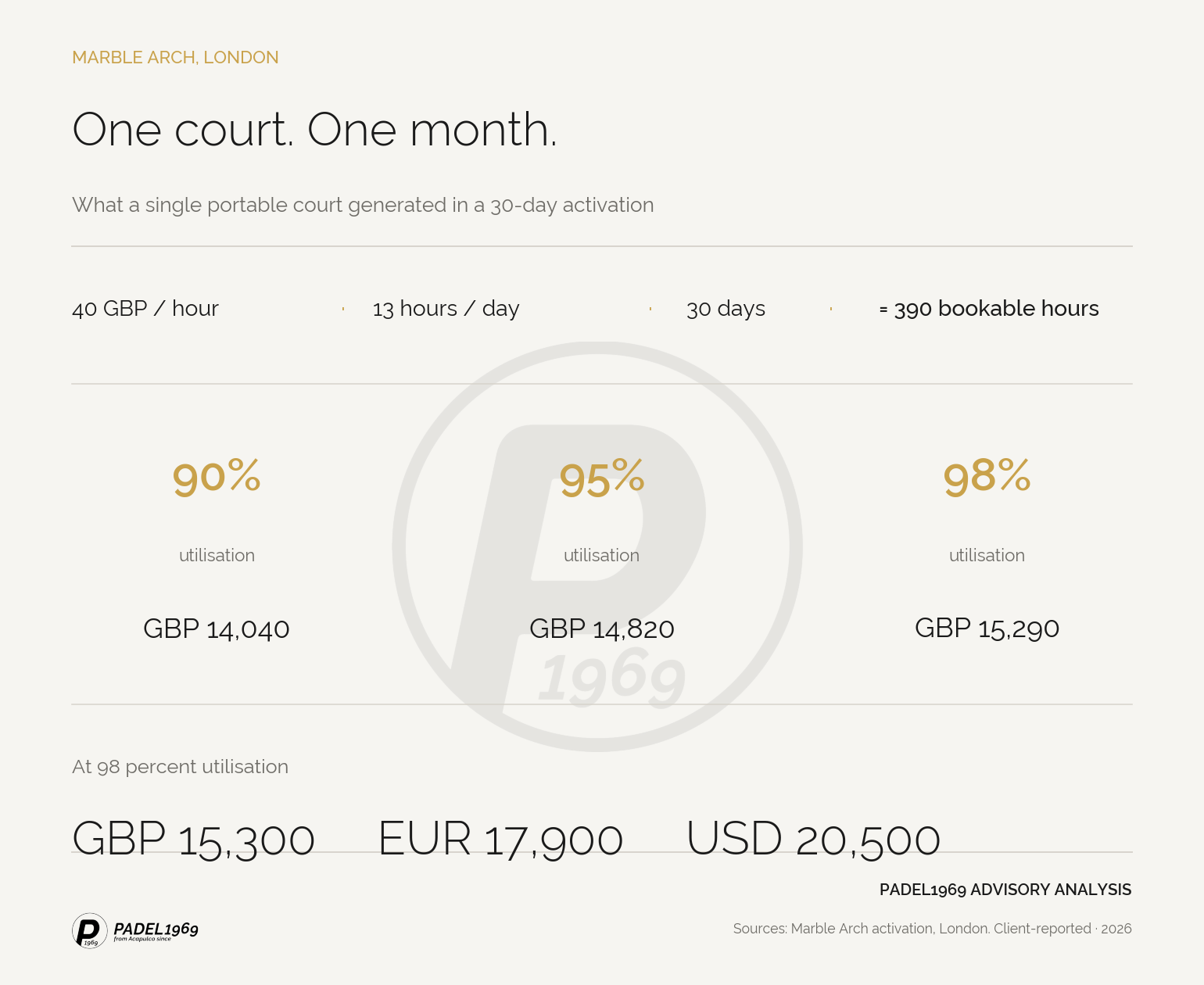
Single-court economics from a 30-day Marble Arch activation.
Why scarcity supports a premium rate
Scarcity supports premium pricing because a single limited court in a prime location controls supply and creates urgency. A short activation window and a capped number of bookable hours concentrate demand, which allows a higher hourly rate than an always-available permanent facility in the same market.
This is the inversion at the centre of the model. A permanent club competes on availability. It wants to be open as many hours as possible, and it prices to fill that capacity. A pop-up earns on the opposite logic. It is limited by design, and the limitation is what justifies the rate. The court will not be at this location next month, and that fact is part of what people are paying for. Managed well, scarcity is not a constraint on revenue. It is a lever for it.
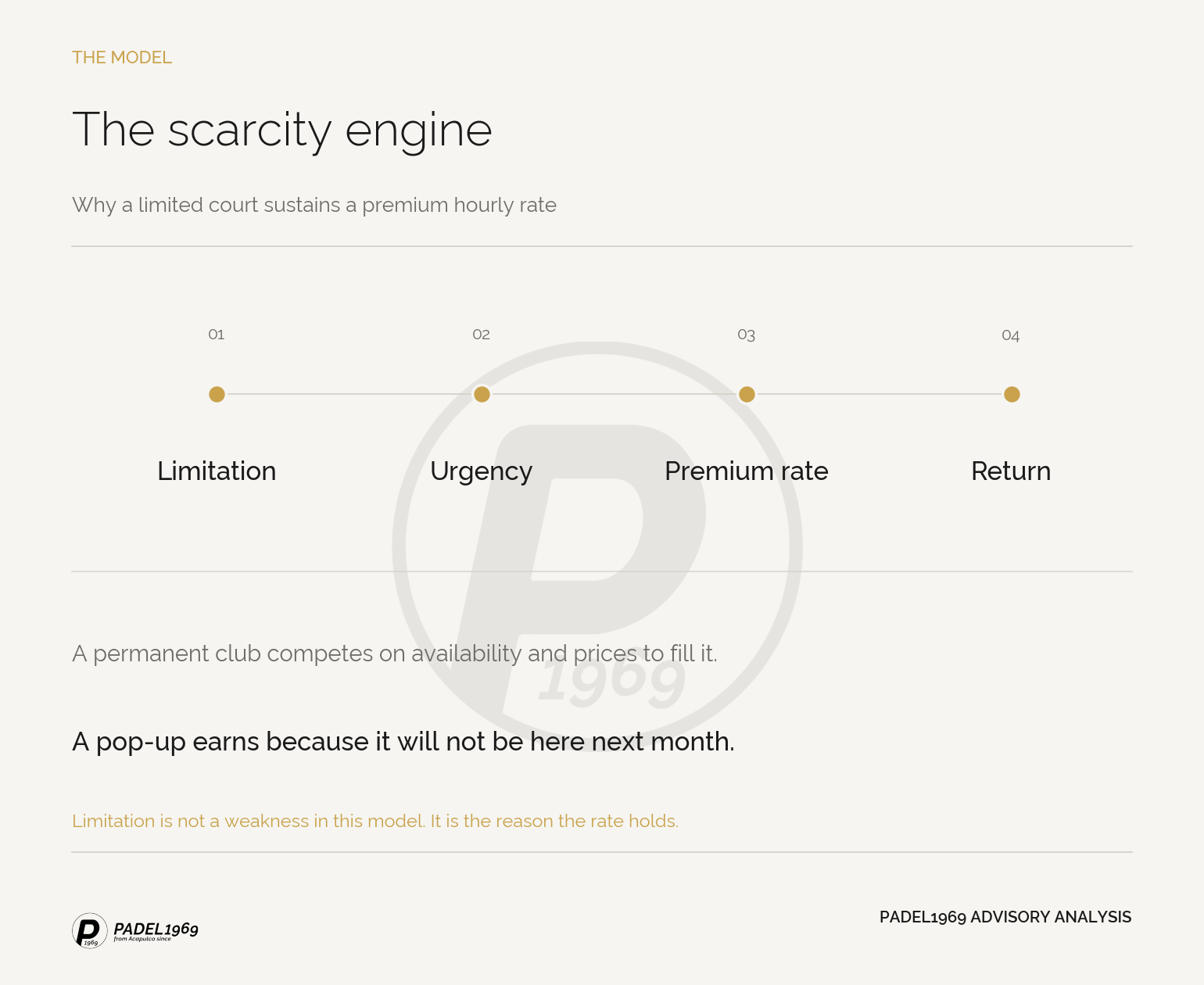
Why a limited pop-up court sustains a premium hourly rate.
The court is not a temporary compromise
A portable court is often assumed to be a lesser version, a demo unit tolerated until the real facility arrives. That is not what this is. It is the same premium structure engineered to move. It is FIP-compliant and built to permanent-installation standard. The steel is available in any RAL colour. The playing surface is available across a wide selection of sport grass colours and qualities. Nothing about the specification signals that it is provisional, because it is not.
That distinction changes the economics. A permanent facility in the wrong location is a stranded cost, sold at a loss or run below potential for years. A portable court in the wrong location is a court in transit. The mistake costs a move, not a building, and the asset holds its value through both outcomes. Set against a permanent build, which in the United Kingdom commonly runs from 25,000 to 40,000 GBP per court before site works, the portable route removes the largest and least reversible commitment from the front of the project.
A 30-day activation at Marble Arch, London
At Marble Arch in central London, a single portable court ran for 30 days, the period set by the activation permit. The court operated 13 hours a day, from 7am to 8pm, at 40 GBP per hour, a rate confirmed by the activation’s organisers. The client reported 98 percent utilisation across the full period, which at 390 bookable hours corresponds to revenue on the order of 15,000 GBP for the month from one court.
The result reflects the two conditions that carry this model. The location was prime, in one of the most visible retail and pedestrian settings in the city. And the run was limited by permit, which enforced the scarcity that sustained both the rate and the fill. The court’s open panoramic sightlines did part of the marketing on their own, converting passers-by into spectators and spectators into players in live conditions rather than in a projection.
Most padel projects commit capital to a location before they have any proof it will perform. A portable court reverses that order. You put the court on the ground, you let the site show you what it generates, and only then do you build. The evidence comes first. The building follows.
Atte Suominen, Founder and CEO, PADEL1969
How a serious operator enters a market
Entering a market with a permanent facility is a single large bet placed before the table has been read. Entering with a portable court is a sequence of small, reversible bets, each informed by the last. The exposure is low because no permanent capital is committed until a site has earned it. The evidence is real because it comes from the field rather than the model. And the court earns from the first day it is installed, generating revenue during the testing period rather than sitting as a cost awaiting validation.
One court. Many locations. The guesswork removed from the part of the project where guesswork is most expensive. If you are planning an entry into a new market, our advisory practice works with operators from the first site test through to a permanent facility.
Selected pop-up projects
A record of PADEL1969 pop-up installations in the field. Further projects will be added here as they are documented.
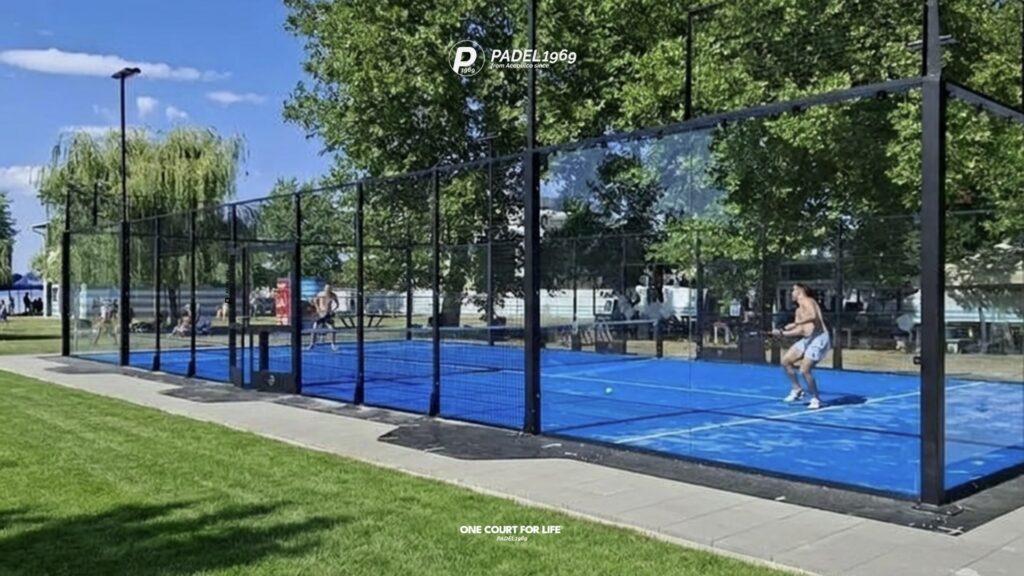
PADEL1969 pop-up panoramic court, outdoor installation with SWIFT™ portable foundation system.
The Premium Pop-Up Panoramic Court in detail
The sections above describe the strategy. This is the court that carries it. The Premium Pop-Up Panoramic Court combines the full-glass PADEL1969 Panoramic enclosure with the SWIFT™ Portable Foundation System. It carries the architectural presence and spectator visibility of the flagship panoramic court on a self-supporting steel base that needs no permanent anchorage to the ground. It installs on almost any flat, load-bearing surface and relocates when the location or the season changes, without the groundworks, the fixed foundations, or, in most cases, the planning permission a permanent build requires.
The enclosure is a continuous 12 mm tempered glass surround on all sides, for open sightlines and a clean profile. Pre-machined parts and a defined on-site sequence keep installation time and specialist labour low, and the court disassembles and reinstalls at a new location as often as required. Because the base is self-supporting, the structure is generally treated as temporary and removable, and is typically permit-free, though local regulations should be confirmed for each site.
At a glance
| Court model | Premium Panoramic, full-glass surround |
| Playing area | 20 m × 10 m interior |
| Total footprint | 21.47 m × 12.94 m including safety zone |
| Glass | 12 mm tempered safety glass, all sides |
| Structure | Galvanised steel, powder-coated, any RAL colour |
| Surface | Monofilament turf, FIP blue as standard |
| Lighting | LED system, from approximately 520 lux |
| Foundation | SWIFT™ Portable Foundation System |
The court suits brand activations and sponsor events, rooftops, terraces, and courtyards, city-centre exhibitions and pop-up tournaments, seasonal, touring, and short-tenancy venues, and sites where a permanent build is not permitted or not wanted.
Every court is supplied and installed under the PADEL1969 Certified programme, with host surfaces confirmed for flatness and load-bearing capacity before installation. Full specifications and warranty terms are provided on request. For a site assessment or a configuration matched to your venue, contact [email protected].
Frequently asked questions
What is a pop-up padel court?
A pop-up padel court is a portable, FIP-compliant court that can be installed and removed without permanent groundworks. It is engineered to move between sites while holding its value, and operators use it to test a location for a defined period before committing to a permanent facility.
How do you test padel demand at a location?
Install a portable premium court on a short lease, operate it for 30 to 90 days at a real hourly rate, and measure utilisation and repeat bookings. Sustained high utilisation at your target price confirms genuine demand. If the numbers hold you build, and if they do not the court moves to the next site.
How much money can a single padel court make?
Revenue depends on the hourly rate, utilisation, and bookable hours. At 13 bookable hours a day and a rate of 40 GBP, a court offers 390 bookable hours a month. At high utilisation this produces on the order of 15,000 GBP, 18,000 EUR, or 20,000 USD from one court in one month.
Is a padel court a good investment?
A padel court can be a sound investment where real demand supports it. The principal risk is building in a location that does not perform, as the Swedish market showed when overbuilding led to widespread closures. Testing demand with a portable court before committing to a permanent build reduces that risk directly. Pop-Up Padel court can be always used in the permanent use at later stage. At PADEL1969 we always follow the same high-standards in padel court manufacturing whether use case is pop-up or long-term installation.
How much does a pop-up padel court cost to run?
A portable court avoids permanent groundworks and building permits, so the main costs are the court, transport, installation, and a short-term site lease. This lowers the upfront commitment against a permanent build, which in the United Kingdom commonly runs from 25,000 to 40,000 GBP per court before site works.
How long does a portable padel court take to install?
A portable premium court is installed in two days rather than the months a permanent facility requires, which is what allows an operator to test several sites in sequence within a single season.
The essentials in other languages
English. What is a pop-up padel court, and why use one? A pop-up padel court is a portable, FIP-compliant court installed in days without permanent groundworks. It lets an operator test real demand at a location, at a premium hourly rate, before committing to a permanent facility. If the site performs, you build. If it does not, the court moves and holds its value.
Deutsch. Was ist ein Pop-up-Padelplatz, und warum sollte man ihn nutzen? Ein Pop-up-Padelplatz ist ein vollständig versetzbarer, FIP-konformer Court, der in wenigen Tagen ohne dauerhafte Fundamentarbeiten aufgebaut wird. Er erlaubt es, die tatsächliche Nachfrage an einem Standort zu einem gehobenen Stundenpreis zu prüfen, bevor man in eine feste Anlage investiert. Trägt der Standort, wird gebaut. Trägt er nicht, wird der Court versetzt und behält seinen Wert.
Español. ¿Qué es una pista de pádel pop-up y por qué utilizarla? Una pista de pádel pop-up es una pista totalmente reubicable y homologada por la FIP que se instala en pocos días sin obra permanente. Permite comprobar la demanda real de una ubicación, a un precio por hora premium, antes de comprometerse con una instalación fija. Si la ubicación funciona, se construye. Si no, la pista se traslada y conserva su valor.
Français. Qu’est-ce qu’un court de padel mobile, et pourquoi l’utiliser ? Un court de padel mobile, ou éphémère, est un court entièrement déplaçable et conforme à la FIP, installé en quelques jours sans travaux permanents. Il permet de tester la demande réelle d’un emplacement, à un tarif horaire premium, avant de s’engager dans une installation permanente. Si le site fonctionne, on construit. Sinon, le court est déplacé et conserve sa valeur.
Português. O que é um campo de padel pop-up e porquê utilizá-lo? Um campo de padel pop-up é um campo totalmente móvel e homologado pela FIP, instalado em poucos dias sem obras permanentes. Permite testar a procura real de um local, a um preço por hora premium, antes de assumir uma instalação fixa. Se o local funcionar, constrói-se. Caso contrário, o campo é transferido e mantém o seu valor.
العربية. ما هو ملعب البادل المؤقت، ولماذا نستخدمه؟ ملعب البادل المؤقت هو ملعب قابل للنقل بالكامل ومطابق لمواصفات الاتحاد الدولي للبادل، ويُركَّب خلال أيام دون أعمال إنشائية دائمة. يتيح اختبار الطلب الحقيقي في موقع معيّن بسعر مميّز للساعة قبل الالتزام بمنشأة دائمة. فإذا نجح الموقع، يبدأ البناء، وإن لم ينجح، يُنقل الملعب ويحتفظ بقيمته.
PADEL1969 SHAPE THE FUTURE OF PADEL
Contact to learn more: [email protected]
Revenue figures are illustrative, based on a rate of 40 GBP per hour across 13 bookable hours per day, from 7am to 8pm, for 30 days. Currency conversions use a mid-market rate of 1 GBP to 1.17 EUR and 1.34 USD as of 12 July 2026, and will vary with the exchange rate.