The Olympic pathway, measured
Padel’s route to the Olympic Games is one of the most discussed subjects in the sport and one of the least precisely understood. This is an account of how padel reaches the Games, by which routes, and on what realistic timeline. It is written in the belief that accuracy is a stronger position than optimism.
PADEL1969 Advisory Analysis 2026 – Welcome to read our research.
One fact reframes the conversation
Most writing on padel and the Olympics opens with momentum: the player numbers, the new courts, the arrival at the European Games. All of it is real. None of it is the thing that decides Olympic inclusion.
The decisive fact is quieter, and it is rarely stated correctly. The International Padel Federation is not recognised by the International Olympic Committee. It holds neither provisional nor full recognition, and it is not a member of the Association of IOC Recognised International Sports Federations.
A note on a common error is worth making early, because it travels widely. The recognised-federations list does contain an entry abbreviated FIP. That entry is the Federation of International Polo. It is not padel. The confusion is understandable, and it has led a number of otherwise careful observers to place padel further along the Olympic path than it stands. Recognition is not a step padel has completed. It is the first gate, and the sport has not yet passed through it.
This matters because recognition is not one option among several. It is the precondition for all of them.
I would rather tell you the real timeline than sell you a date I cannot support.
Atte suominen, CEO & founder padel1969
The structure behind the word Olympic
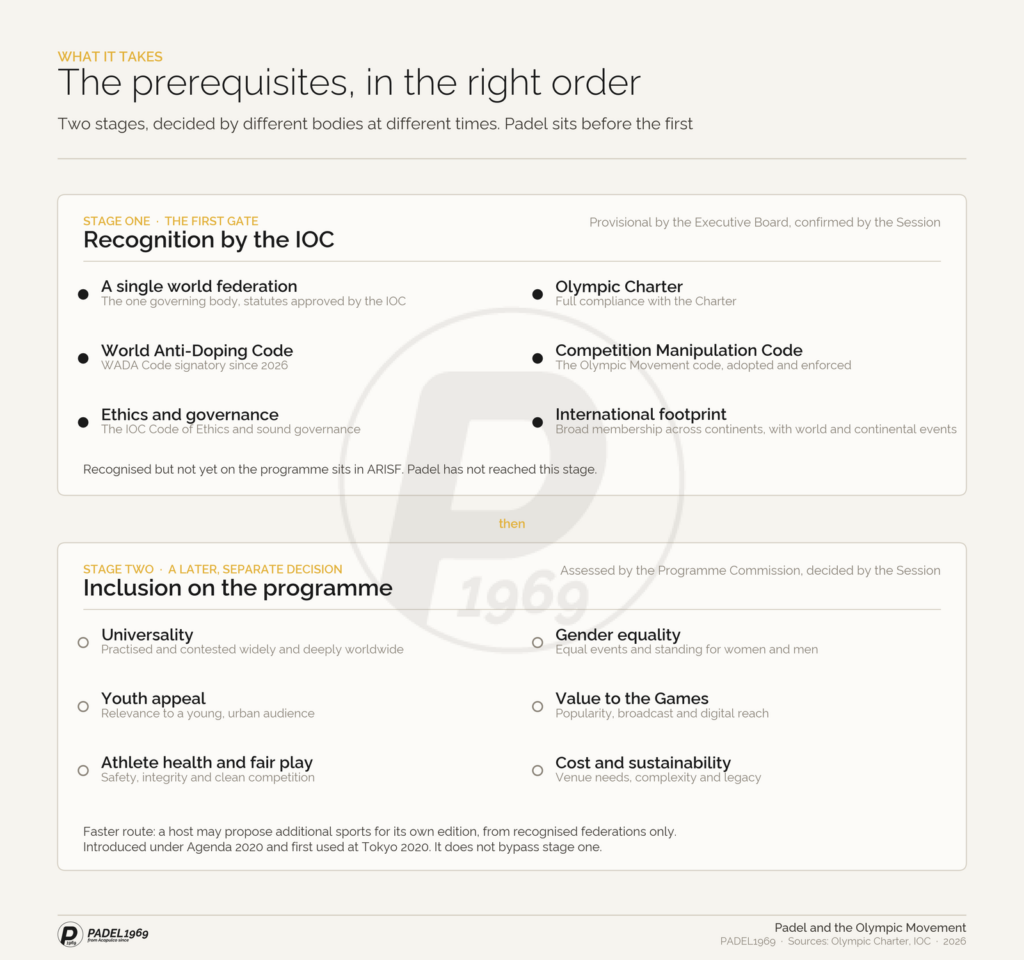
A federation earns IOC recognition by meeting a defined standard: a single global governing body, several years of continuous existence, wide international practice, compliance with the World Anti-Doping Code, and demonstrable good governance. Recognition is granted provisionally by the IOC Executive Board and confirmed by the IOC Session. Only then does a federation become eligible for the recognised tier whose sports are not yet on the Olympic programme, and, above that, the tier of federations whose sports are contested at the Summer Games.
Padel sits below all of it, in the position marked not recognised. Every route to the Games begins by leaving that position, and no amount of growth substitutes for the step.
Four routes to the Games, ordered by realism
There are four credible routes by which padel could reach the Olympic Games. They are often discussed as if interchangeable. They are not. They differ in mechanism, in gatekeeper, and in timeline, and only one of them is available to padel today.
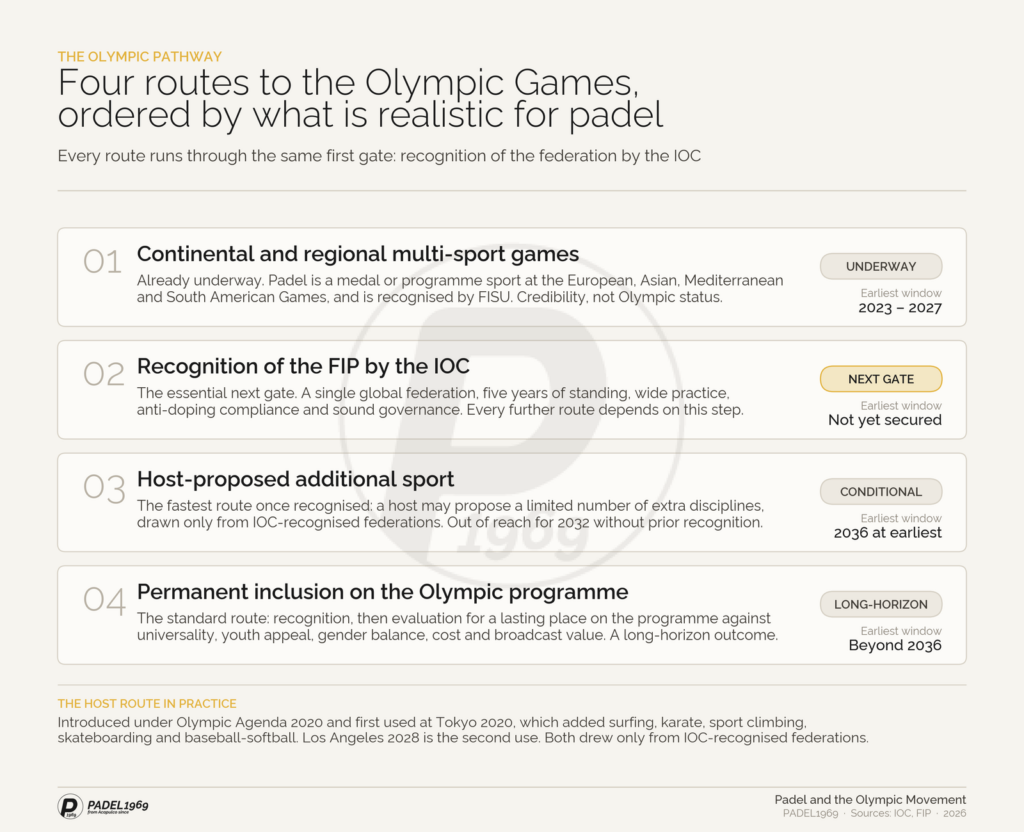
The first is the continental and regional multi-sport games. This is the route padel is already travelling, as a medal or programme sport at the European, Asian, Mediterranean and South American Games, and through recognition by the world university sport body. For squash, these events became part of the formal Olympic qualification structure, which is a measure of how seriously the movement reads them. They are real progress. They are also not the Olympics, and it is worth being exact: a medal at a continental Games is a credential presented toward the programme, not a place on it.
The second is recognition of the federation by the IOC. This is the essential gate described above. Until it is passed, the two routes that follow remain closed.
The third is the host-proposed additional sport. This mechanism was introduced under Olympic Agenda 2020 and used for the first time at Tokyo 2020, where the host added five sports of its own: surfing, karate, sport climbing, skateboarding and baseball-softball. Los Angeles 2028 is the second use of the same power, with squash, cricket, flag football, lacrosse and baseball-softball. The important detail is the one the IOC states plainly: a host may propose additional events for its edition only, and only from sports governed by federations the IOC already recognises. It is the fastest route in principle, and it is closed to any sport that has not passed the recognition gate. For padel that rules out Brisbane 2032, whose programme is being decided now, and it makes 2036 the earliest edition at which a host could propose padel, on the condition that recognition is secured well in advance.
The fourth is permanent inclusion on the Olympic programme: recognition followed by evaluation for a lasting place, judged on universality, youth appeal, gender balance, cost and broadcast value. For padel this is a long-horizon outcome, realistically beyond 2036.
Recognition is not one option among several. It is the precondition for all of them.
Where padel actually competes
Precision here is itself a position. Padel’s confirmed presence in major multi-sport events is genuine and expanding, and it deserves to be stated accurately rather than rounded up.
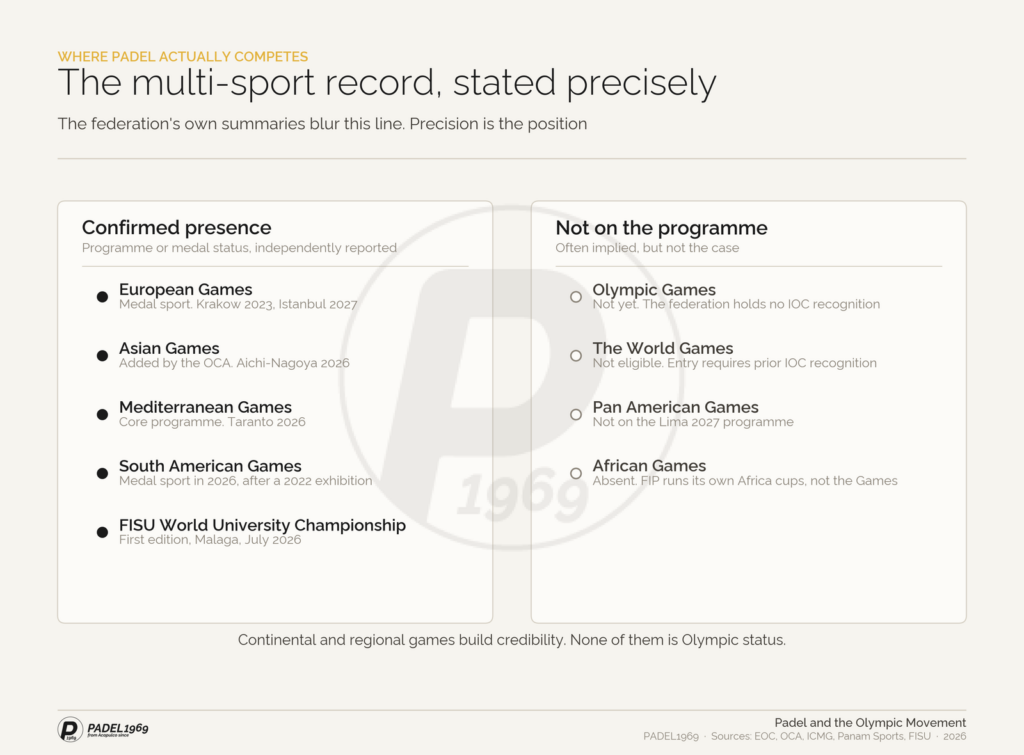
Confirmed presence on the left, common overstatements on the right. The line between them is where authority is made.
Two clarifications keep the record honest. Los Angeles 2028 does not include padel; the five sports its host added were baseball-softball, cricket, flag football, lacrosse and squash. And padel is at times described as present where it is not. It is not on the Pan American Games programme for Lima 2027. It is not in The World Games, whose entry requires prior IOC recognition. It is not on the African Games programme, although the federation has recently placed the two together in its own summaries. What padel holds in Africa is its own continental competition, the FIP Africa Padel Cup, awarded to Egypt for 2027, which is a federation event rather than the continental multi-sport Games. The distinction is small, and it is exactly the kind of distinction that authority is built from.
What inclusion actually hinges on
The IOC does not weigh enthusiasm. It weighs a defined set of qualities, and padel presents well against most of them.
Governance is unified, the more so since the 2024 consolidation of the professional tour. Gender balance is real, with men’s, women’s and mixed competition at parity, which aligns with the movement’s stated priorities. The sport is young, urban and telegenic. Anti-doping now meets the formal standard: in July 2026 the federation became a signatory to the World Anti-Doping Code, after a two-year process with the International Testing Agency, which clears one of the defined requirements for recognition without granting recognition itself. Where padel is weaker is universality. The sport remains concentrated in Europe and Latin America, with elite depth still thin across much of Africa, North America and East Asia. This is the criterion most likely to hold padel back, and it is better named plainly than buried beneath an aggregate participation figure.
The comparison that instructs is squash. Squash was recognised by the IOC in 1986 and still waited close to four decades, failing at four successive Games before entering through the host route for 2028. Recognition was necessary and, for a long time, not sufficient. Pickleball, padel’s most cited rival, is in some respects behind, having unified its global governance only in 2025. Padel sits between the two, nearer to squash’s eventual-success profile than to pickleball’s fragmentation. It has not yet reached even squash’s starting line, which was recognition.
The Paralympic pathway is a separate movement
There is a further route that most coverage omits, and it is not a variation on the four above. It leads to a different destination under a different authority. The Paralympic Games are governed by the International Paralympic Committee, an organisation distinct from the IOC. The two are bound at one level and independent at another, and the distinction is routinely missed.
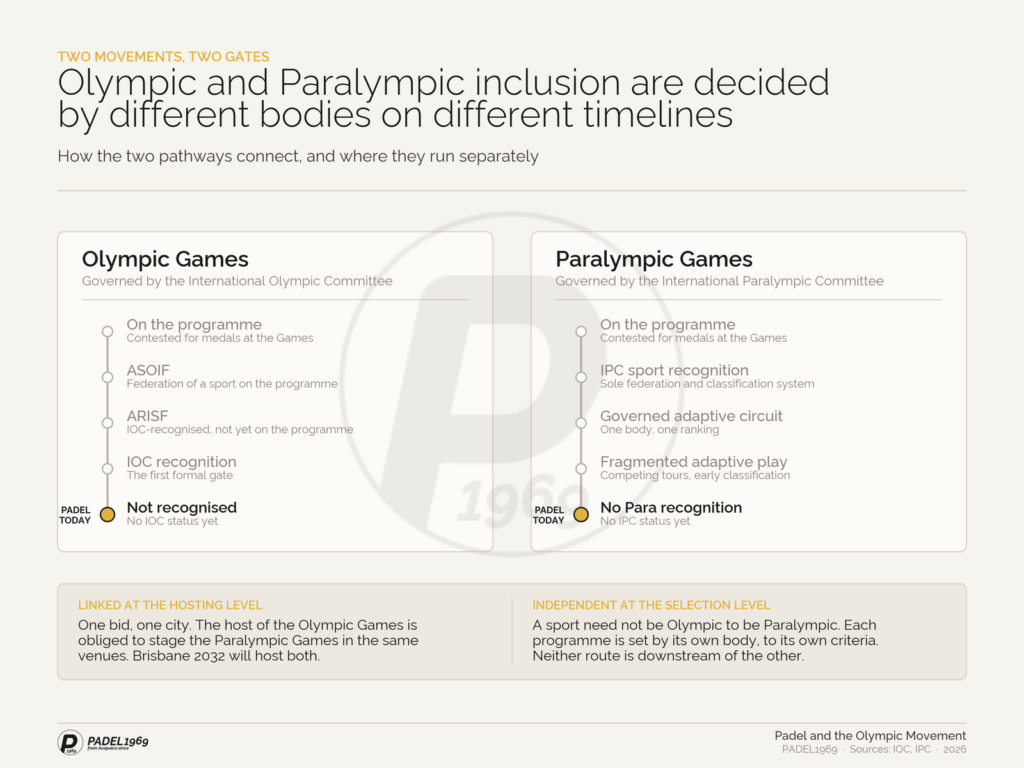
At the hosting level the two are joined. Under the one bid, one city principle, the host of the Olympic Games is obliged to stage the Paralympic Games immediately afterward, in the same venues. Brisbane 2032 will host both. At the level of sport selection they are separate. The Olympic programme is set by the IOC; the Paralympic programme is set by the IPC, against its own criteria, including a functional classification system without which a Para sport cannot exist. A sport need not be Olympic to be Paralympic, and the reverse holds equally. Paralympic status is not downstream of Olympic status. It is its own pathway with its own gate.
Padel’s position on this track mirrors its Olympic position in structure. Adaptive and wheelchair padel exist and are developing. The federation staged a Wheelchair World Padel Championships in 2023, and separately the Inclusive Padel Tour, founded in 2022 by the Paralympic sprinter Alessandro Ossola, has built a standing and wheelchair circuit and signed a memorandum with World Abilitysport, a body recognised by the IPC, to develop the sport toward the World Abilitysport Games. The ambition of Paralympic inclusion has been stated openly. The obstacle is the same one in a different form: the governance of adaptive padel is currently divided, and classification is early. Divided governance is what delays recognition, on either track.
For a manufacturer this pathway is not abstract. Accessibility is an engineering standard, not a courtesy. The federation’s own court regulations call for a clear access of 1.2 metres for a sports wheelchair, while permitting entry gaps as narrow as 0.72 metres in another configuration, which no sports wheelchair will pass. A court built to the true standard is a court that can host the adaptive game. That is a decision made at the drawing stage, and we regard it as part of building a court properly rather than an accommodation added afterward.
The timeline, as it actually reads
The calendar is denser than the Olympic question alone suggests, and most of the near-term activity sits outside the Olympic programme.
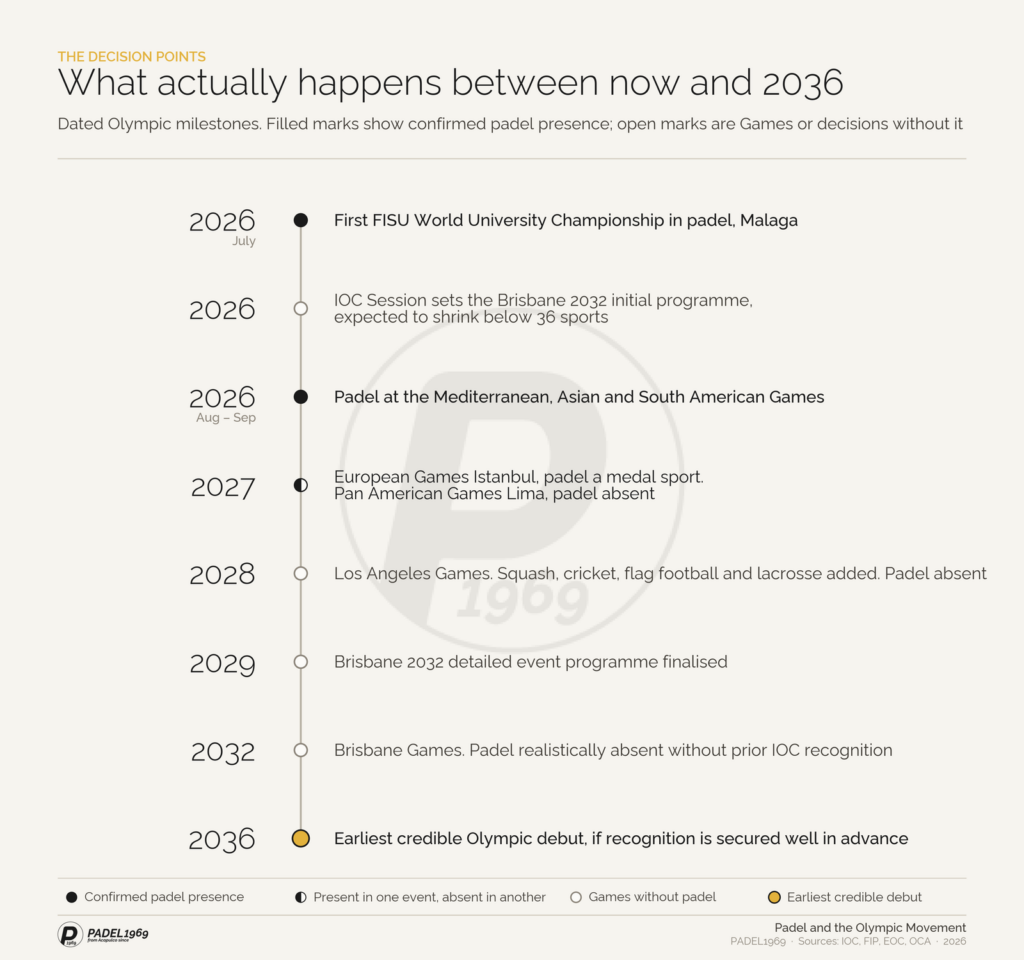
Through 2026 the sport appears at the first university world championship in Malaga and across the Mediterranean, Asian and South American Games, while the IOC Session sets the initial Brisbane 2032 programme, which is expected to be smaller than the record thirty-six sports of Los Angeles. In 2027 padel is a medal sport at the European Games in Istanbul and absent from the Pan American Games in Lima. In 2028 Los Angeles proceeds without it. Around 2029 the detailed Brisbane event programme is finalised. In 2032 Brisbane hosts, realistically without padel in the absence of prior recognition. The earliest credible Olympic debut is 2036, and only if recognition is secured well before it.
What would actually change the outlook
Four developments would move padel materially closer, and each is observable rather than speculative: an IOC announcement of provisional recognition for the federation; admission to the recognised-federations tier; a statement from a 2036 or later organising committee shortlisting padel; and measurable elite-level growth in the regions where the sport is currently thin. Until at least the first of these occurs, 2032 should be treated as improbable and 2036 as the earliest credible target.
Olympic status would make the sport more valuable, but it is not the reason we exist.
Atte suominen, CEO & founder padel1969
Build regardless of the committee
None of this is a reason to wait. The operators building serious padel today are not doing so in anticipation of a decision in a committee room, and they are right not to. Olympic status, if it comes, will raise the ceiling on the value of the sport. It has never been the foundation of that value. The foundation is the quality of the venue, the depth of the community that forms around it, and the judgment of the people running it. Those are within an operator’s control, and they compound whether or not the five rings ever appear on a padel court.
We SHAPE THE FUTURE OF PADEL with our clients, one court and one club at a time.
Atte suominen, CEO & founder padel1969
We build for that horizon, and we follow the Olympic question precisely because it deserves to be understood rather than sold. When the institutions move, and they will take their time, the operators who built to standard will be the ones ready to meet it.
Summary: the checklist
Read in one pass, the position is straightforward. Padel meets most of what recognition requires. Two items remain outstanding, and recognition governs both.
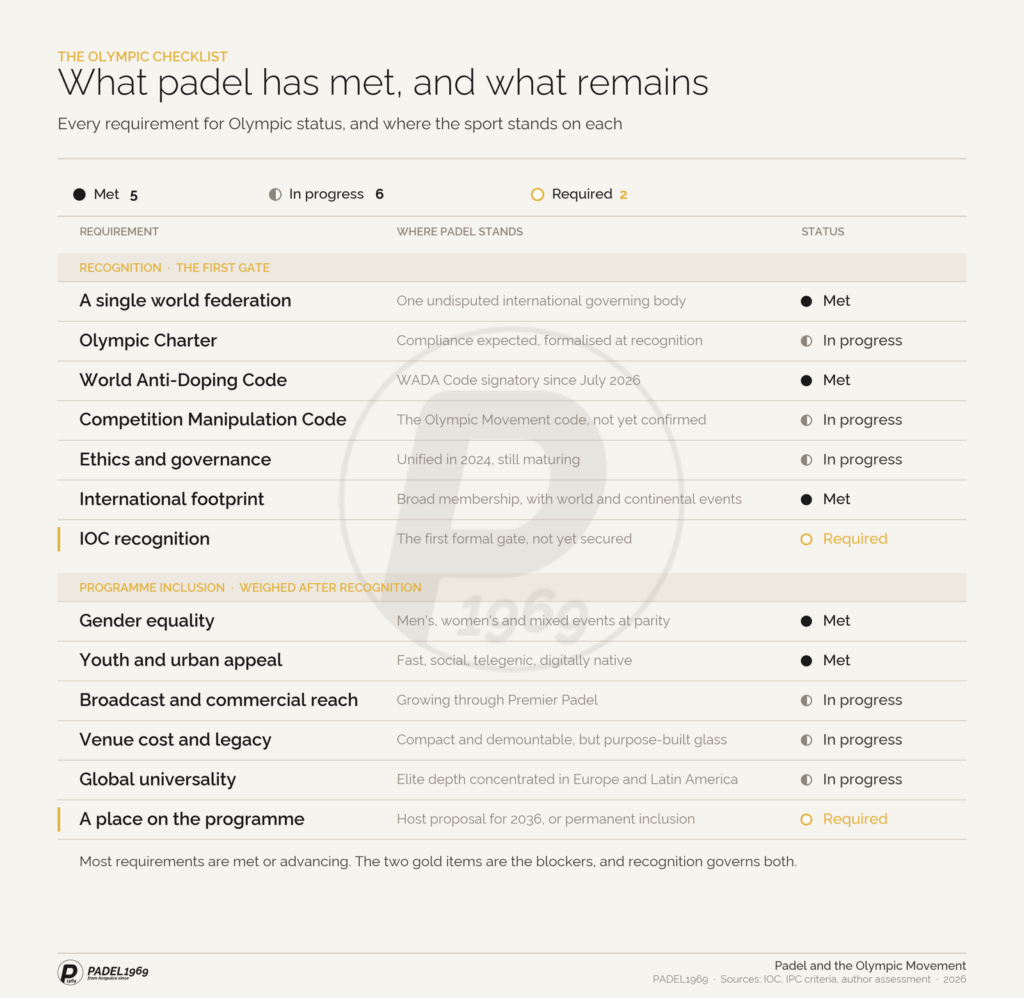
The timeline does not make us nervous. It makes us selective.
Atte suominen, CEO & founder padel1969
RELATED READING
Padel as a real estate asset class | Why the court-hour, not the court count, is the unit that holds value.
Advisory | How we work with operators building benchmark clubs.
Sources: PADEL1969 Advisory Analysis 2026, published statements and programmes of the International Olympic Committee, the International Paralympic Committee, the International Padel Federation, the European Olympic Committees, the Olympic Council of Asia, the International Committee of the Mediterranean Games, Panam Sports and the International University Sports Federation, mid-2026. Participation and court figures attributed to the federation are federation-reported.
PADEL1969 advises the investors, developers, and operators building padel into real estate, and manufactures the courts that sit at the centre of those projects. The work begins well before the court: the financial assumptions, the location chosen on evidence, the marketing and community that fill the hours, the sponsorships priced properly. If you are weighing padel as part of a residential, hospitality, or mixed-use scheme, our Advisory practice works on exactly these questions, and our Premium courts are engineered for the length of a real estate hold, not the length of a season.
SHAPE THE FUTURE OF PADEL.