
Padel marked Olympic Day with a portrait of itself. The figures describe a game that has become an institution.
Every year on 23 June, the Olympic movement pauses to consider sport and its place in the world. This year the International Padel Federation used the occasion to set out where the game stands. The picture it drew is worth reading closely, because it describes something that has happened quietly and quickly: a regional pastime becoming a global sport with the structure to match.
The scale
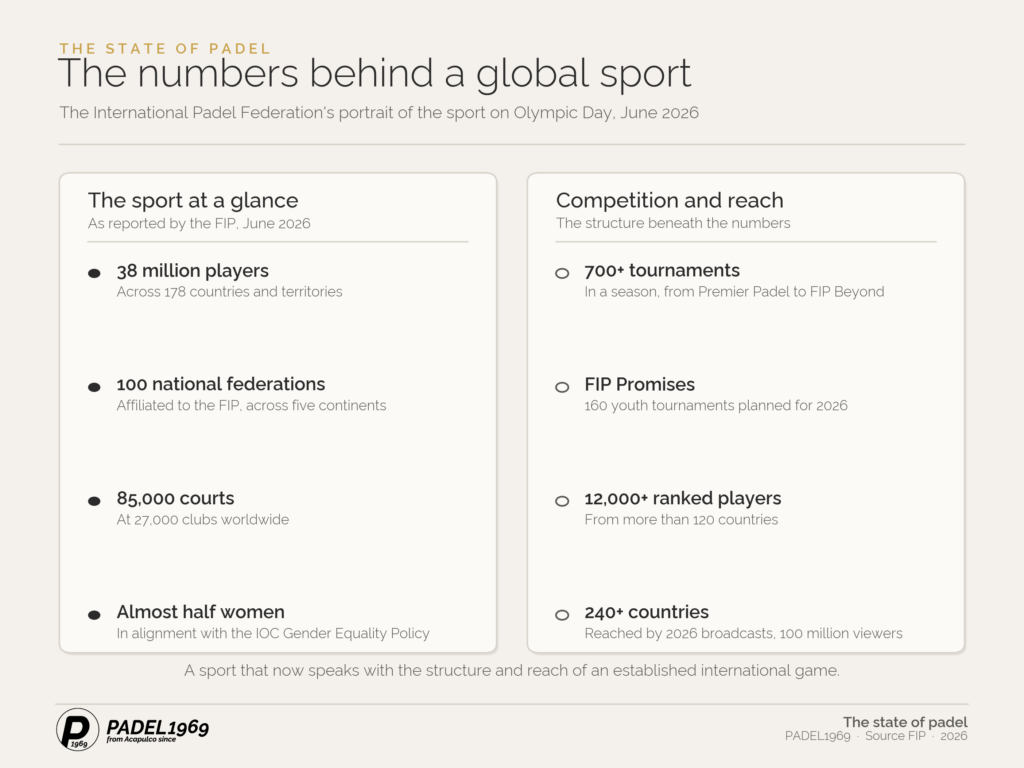
The federation reports thirty-eight (38) million players across a hundred and seventy-eight (178) countries and territories, playing on eighty-five thousand (85.000) courts at twenty-seven thousand clubs. One hundred national federations, spread across five continents, are now affiliated to the FIP. Almost half of all players are women, a balance the federation notes sits in full alignment with the IOC Gender Equality Policy.
These are large numbers, and it is tempting to stop at the largest of them. The more telling figure is the hundred federations. Player counts move with fashion. A governing structure spanning five continents is what separates a popular game from a lasting one, and it is the foundation on which everything else rests.
The structure beneath
The competitive architecture now runs as a pyramid. Premier Padel sits at the summit, beneath it the CUPRA FIP Tour and FIP Beyond, together more than seven hundred tournaments in a season. Below the professional tiers is the youth pathway, FIP Promises, with a hundred and sixty tournaments planned for 2026 and several thousand players aged twelve to eighteen already competing this year. The world ranking now records more than twelve thousand players from over a hundred and twenty countries.
The interesting detail here is not the summit but the base. A sport is only as deep as the tier feeding it, and the width of the youth pathway is where the next two decades of the game are being decided.
Reach follows the same pattern. The federation’s 2026 events are broadcast in more than two hundred and forty countries, with a projected audience above a hundred million, and the FIP now ranks among the fifteen most-followed international federations on Instagram.
The Olympic movement
Padel’s presence in the multi-sport calendar is now continuous rather than occasional. The sport features in the European Games, the South American Games, the Asian Games, the Mediterranean Games and the African Games, alongside the FISU University Championships that bring it onto the world’s campuses.
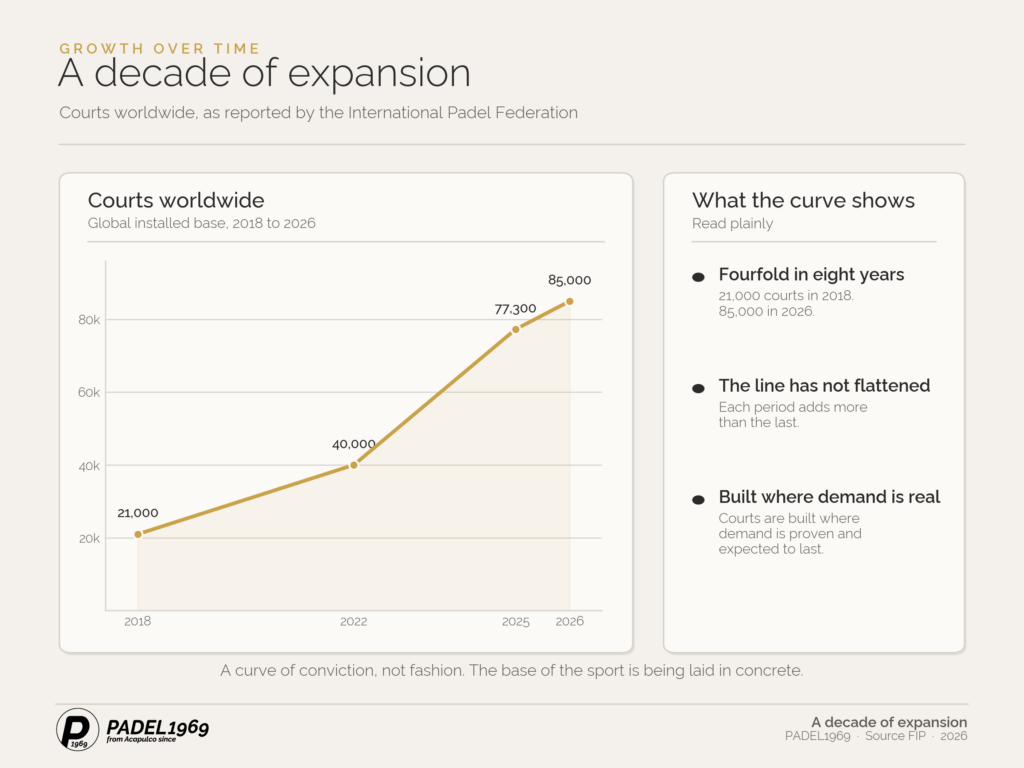
This is the quiet headline of the day. Olympic standing is not granted in a single decision. It is earned through years of visible, well-run competition on the multi-sport stage, in front of the audiences and officials who matter. Padel is now doing exactly that, methodically. The federation frames the Games as its ambition, and for the first time that ambition has a route rather than only a wish.
In closing
Olympic Day is, by design, a moment for a sport to state its case. Padel’s case is strong, and it is grounded in structure rather than noise: a global federation, a deep competitive pyramid, a serious youth pathway, and a steady advance through the events that lead toward the Games. For those who have built in this sport since its beginning, the report reads less as a surprise than as confirmation of what the trajectory has long implied.
Source: International Padel Federation, “Padel celebrates Olympic Day: the numbers behind a global sport on the path to its dream,” June 2026. Figures as reported by the FIP.