by Atte Suominen, Founder and CEO of PADEL1969
Most padel club projects begin with a number. An investor decides on four, six or ten courts, and that number then shapes the building, the budget and the business plan. It is a natural way to start, and many clubs have opened successfully this way.
At PADEL1969 we start in a different place. Every advisory conversation begins with two simple questions: why do you want to enter the padel business, and what impact do you want to make? The number of courts comes later, as a result of those answers. We work this way because we see it as the stronger approach for investors who want to stay in the market for the long term.
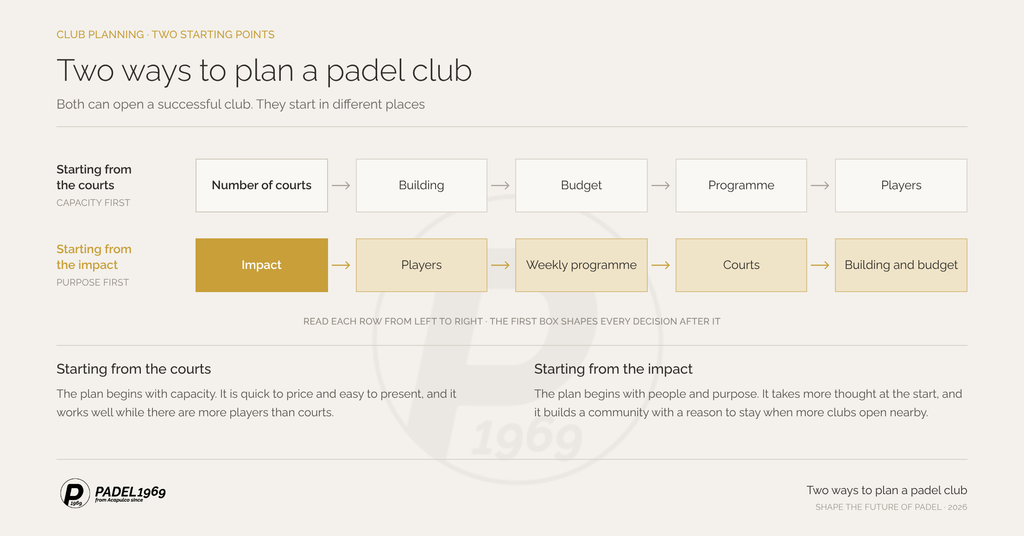
Two ways to start a padel club project
It is easy to understand why many projects start with the number of courts. A number feels like a plan, it is easy to price, and it is easy to show to a bank or a board. When you start this way, the other decisions follow from that number. You look for a building that can hold the courts, you build the financial model around them, and you plan the weekly programme later.
When you start from the impact, the order changes. You first decide what the club is for and who it will serve. Then you plan the weekly programme, and only after that the number of courts, the building and the budget. German has a useful way to describe the difference in focus: a Padelhalle, a padel hall, is about the space, while a Padelclub, a padel club, is about the people who play there.
Start with the end goal
In their book How Big Things Get Done, Bent Flyvbjerg and Dan Gardner explain an idea they call thinking from right to left. Imagine a project plan on a sheet of paper, with the first idea on the left and the finished project on the right. Most people start on the left and move forward step by step. The authors found that projects that succeed usually start on the right. They first get a clear picture of the end goal, and then they work backwards to build the plan.
The authors also describe how the architect Frank Gehry begins a project by asking his client why they want to do it, and he does not accept a quick answer. A padel club is much smaller than a museum, but the same idea works. The impact you want is on the right side of the page, and the courts are somewhere in the middle.
Why impact matters when the market fills up
In many markets, padel is still growing and new clubs fill up quickly. In that phase, both ways of planning can work well. The difference often shows later, when more clubs open nearby and players have more places to choose from.
A club that was planned around a clear impact gives players a reason to stay: their league, their coach, their friends and the feeling that the club belongs to them. This is why we see the impact approach as the more powerful and longer-lasting choice for investors who want to stay in the market after it becomes crowded. Our article on why padel club operators fail looks more closely at what happens in that phase.
What we mean by impact
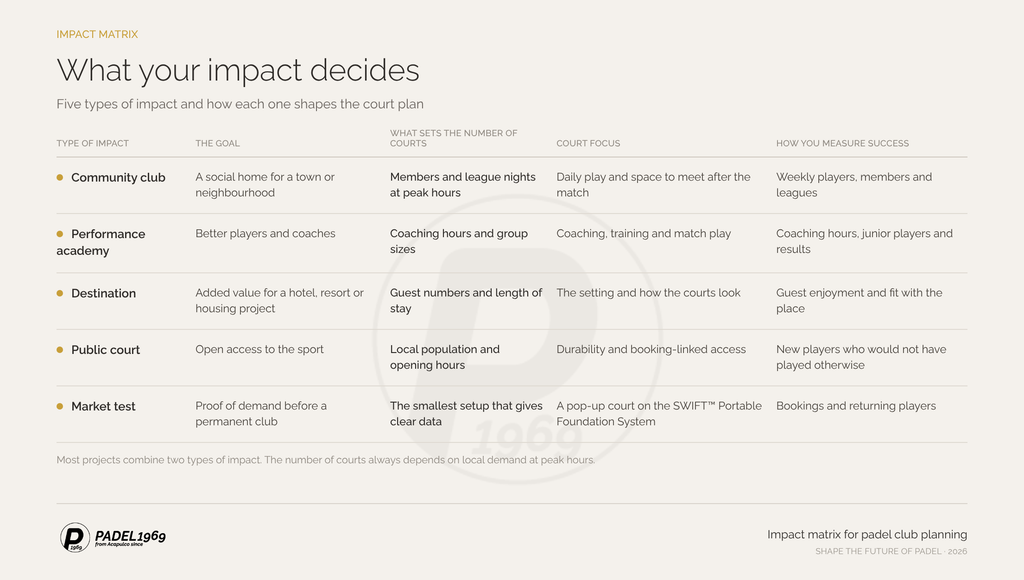
Impact is not a slogan. It is a clear description of what should be different because your club exists, and it should be clear enough that you can measure it later. In our work with investors, we usually see five main types of impact.
A community club – The goal is to create a social home for a town or a neighbourhood. You measure success by the number of members, the leagues you run and how many people play every week.
A performance academy – The goal is to develop good players and coaches. You measure success by coaching hours, junior programmes and results in competitions.
A destination – The goal is to add value to a hotel, a resort or a housing project. You measure success by how much guests enjoy it and how well it fits the place. We look at this in more detail in Padel:
A public court – The goal is to give more people access to the sport. You measure success by how many people play who would not have played otherwise.
A market test – The goal is to find out if there is enough demand before you build a permanent club. You measure success by bookings and by how many players keep coming back over a set period.
All five are good reasons to build, and each one leads to a different club. Most projects combine two of them, but it is very hard to succeed by trying to be all five at once. Our article on the smart way to build a thriving padel club looks at the different skills it takes to build a strong club.
How impact shapes your court plan
When the impact is clear, planning the courts becomes much easier, because it helps you make four key decisions.
How many courts – The number should come from demand. Think about who will play, how often they will play and at what times of day. Every market has a limited number of peak hours, so the right number of courts is the number you can realistically fill at those times.
Which courts – A community club, an academy and an event venue need different things from their courts. Whether you choose Premium Classic, Premium Panoramic or Premium Tournament courts depends on how the club will be used: for daily play, coaching, watching or events. All PADEL1969 Premium Court models are FIP-compliant, and you can choose the grass colour and quality and any RAL colour for the steel structure.
The layout – The space around the courts also depends on your impact. A community club needs room for people to stay and talk after a match, while a tournament venue needs room for people to watch. For choosing the place itself, read great or right location for a padel club.
The phasing – When you plan from impact, you often find that the first phase should be smaller than your first idea, with land or space kept free for more courts later. In a new market, a pop-up court on the SWIFT™ Portable Foundation System by PADEL1969 lets you test demand before you commit to a permanent club. For a public court, a lockable door linked to the booking system can give people access without staff on site all day.
Five questions to answer before you count courts
- Why do you want to enter the padel business? Be honest with yourself. Making a return on your money, a personal passion, a family legacy and helping your community are all valid reasons, but each one leads to a different club.
- Who is the club for? Try to name the players: beginners, juniors, competitive adults, company groups or hotel guests.
- What should change in your city or region because your club exists? If you cannot answer this yet, it is too early to decide the number of courts.
- What does a full week at your club look like? Think about leagues, coaching, social evenings, company events and open play. Good programmes are what fill courts.
- How will you measure success after five years? Occupancy is important, but so are returning players, members and the strength of the community around the club.
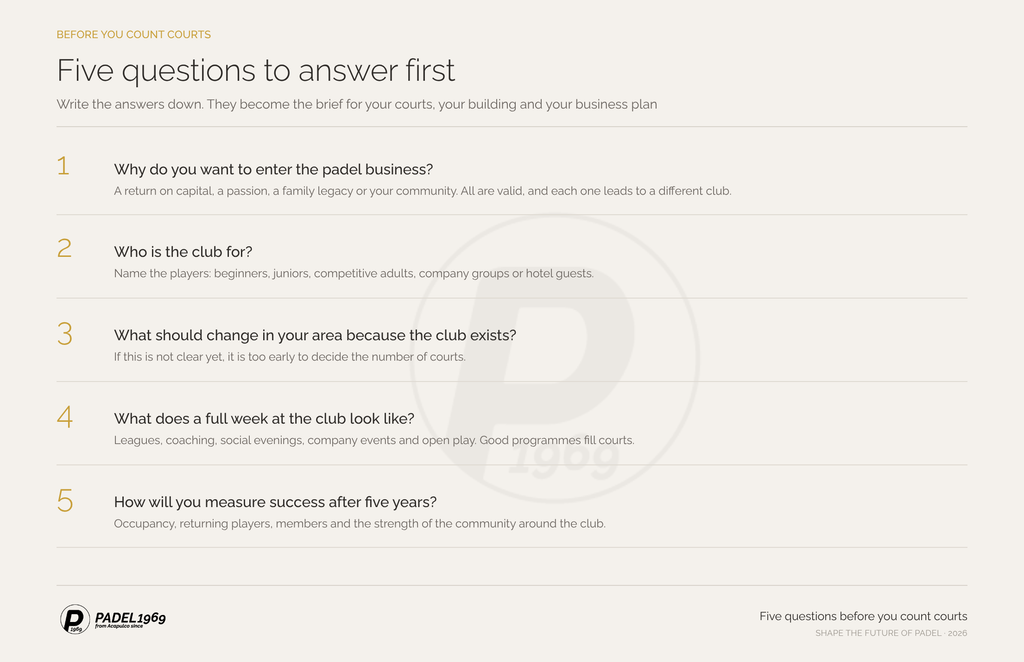
Write your answers down. They become the brief for your court plan, your building and your financial business plan.
Why the order matters even more with premium courts
Courts are the foundation of every padel club, and nothing else in the club works without them. A premium court is also a long-term investment that will serve players for many years. That is exactly why it is worth making the decisions in the right order, because a court built for one purpose will stay with you for a long time.
ONE COURT FOR LIFE® by PADEL1969 is our promise to build courts that last, and the impact you choose decides how that foundation should be built. For a wider view on long-term investment in the sport, read our article on how to invest responsibly in the future of padel.
Start with the right question
If you are planning a padel club, start with the impact you want to make. You can come to us with your answers, or with the questions still open. We will work through them with you and turn them into a court plan, a layout and an investment plan in clear phases.
Book a free Fast Track Call:
calendly.com/padel1969/fast-track-1st-call, or send your project details to [email protected]
Frequently asked questions
How many padel courts should a new club have?
There is no single right number for every club. The right number depends on the impact you want to make, the players you want to serve and how many courts you can realistically fill at peak times. Answer these questions first, and then decide the size of the club.
Is it wrong to start with the number of courts?
No. Many clubs have opened successfully that way, especially when demand is high. We see the impact approach as the stronger choice for investors who want their club to stay strong after the market fills up, because it builds a community with a reason to stay.
What does impact mean for a padel club investor?
Impact means what should change because your club exists. It could be a stronger local community, a pathway for junior players, an attraction for a hotel or resort, or more public access to the sport. It should be clear enough that you can measure it.
Can a padel club start small and add more courts later?
Yes, if you plan for it from the start. In a new market, it is often the smarter choice to keep land or space free for future courts. A pop-up court can also help you test demand before you build a permanent club.
How does PADEL1969 advisory start?
It starts with why you want to enter the padel business and what impact you want to make. The court plan, the building and the business plan all follow from those answers.
Source: Bent Flyvbjerg and Dan Gardner, How Big Things Get Done (2023), Chapter 3, Think from Right to Left.
PADEL1969 | SHAPE THE FUTURE OF PADEL
Contact for more: [email protected]